
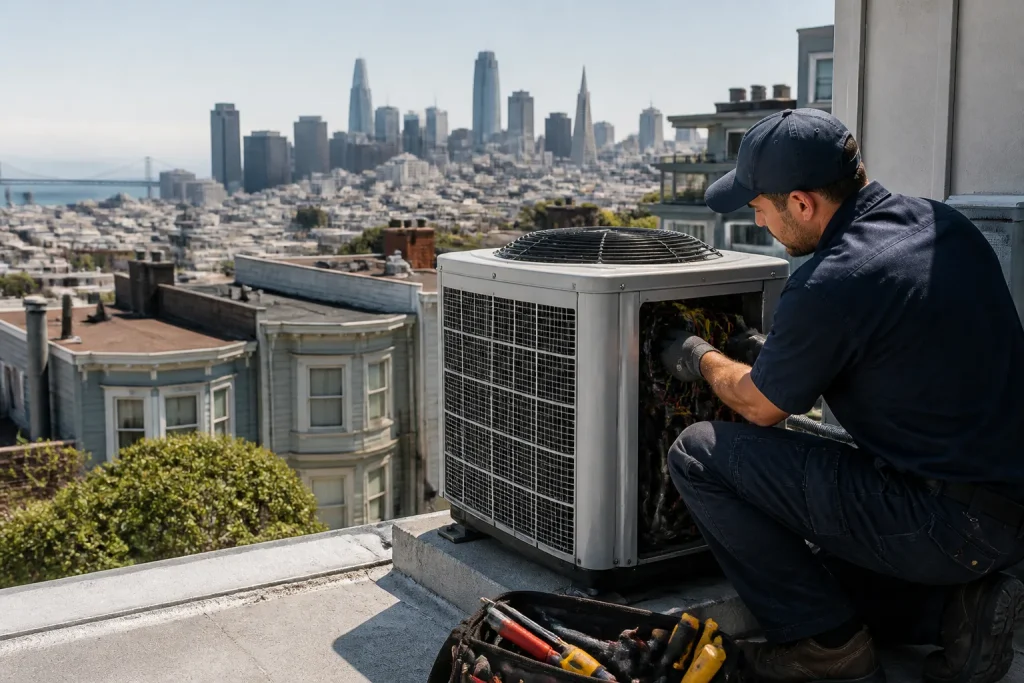
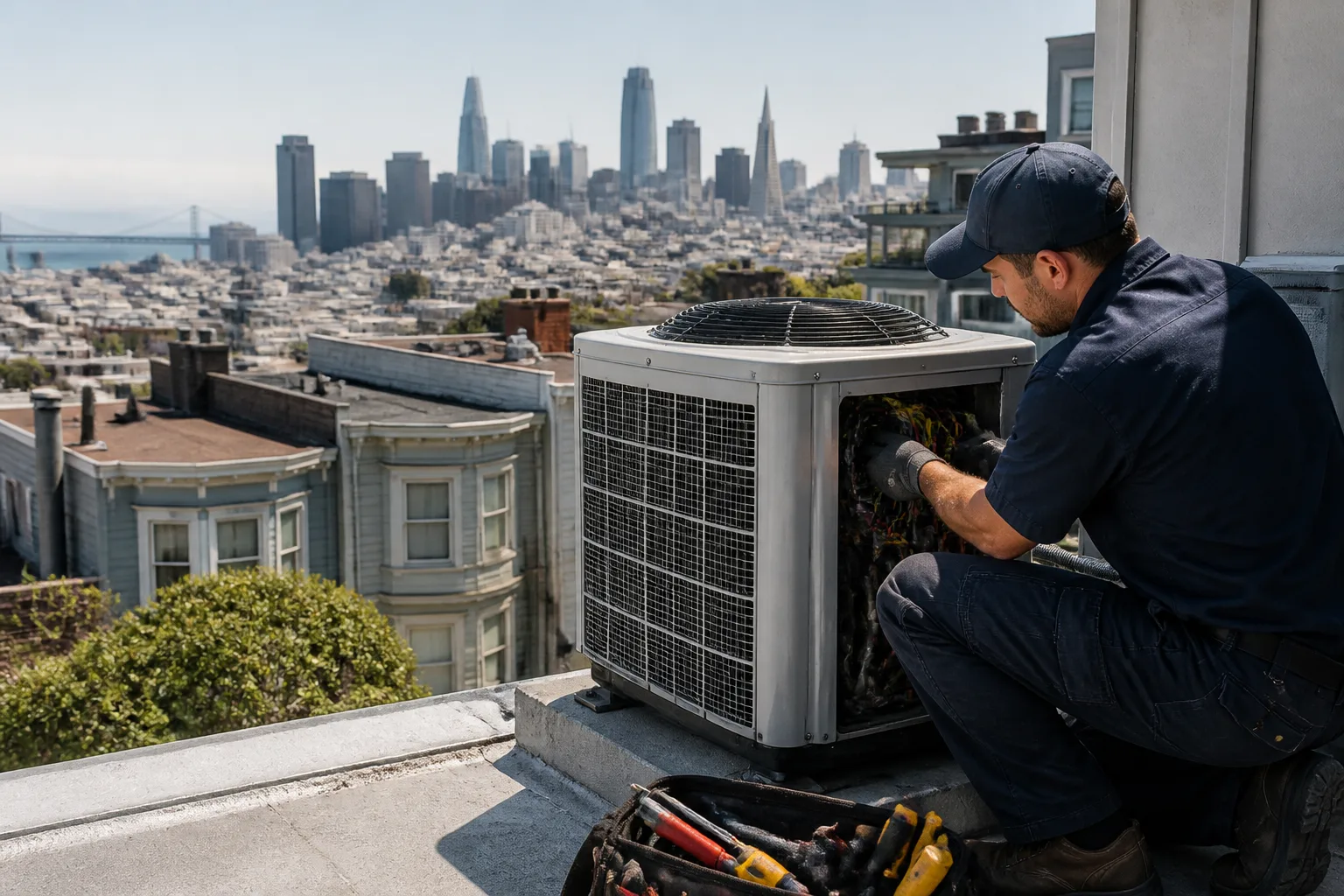
Emergency AC Repair & Installation Near Me: What San Francisco Homeowners Should Do First
When your AC fails during a San Francisco heat wave, the first thing to do is check your thermostat settings and circuit breaker before calling anyone. About 30% of emergency calls we get in the city turn out to be simple fixes that cost nothing to resolve. If those two checks don’t restore cooling, shut the system down completely and call a qualified technician. Daniel personally handles emergency calls for Northstar Heating & Air San Francisco, and you can reach us at (855) 600-3322 for same-day service.
Here’s the mistake most homeowners make: they panic and start flipping switches, resetting breakers repeatedly, or trying to force the system to run. That can turn a minor electrical issue into a fried compressor. We’ve been called to homes in the Sunset District where a homeowner burned out a $2,800 compressor trying to “get it going one more time” before calling. A decade of doing this right has taught us that patience in the first ten minutes saves thousands.
Why San Francisco’s Climate Makes AC Emergencies Tricky
San Francisco’s microclimates create AC problems that don’t exist in other cities. Your system might work fine in the foggy Richmond but struggle in Potrero Hill’s afternoon heat. The temperature swing between the western and eastern neighborhoods on the same day can exceed 25 degrees. That means your AC works harder in some parts of the city, and “emergency” has different definitions depending on where you live.
We see this constantly. A homeowner in Noe Valley calls us in September when their system can’t keep up with Indian summer temperatures. Meanwhile, someone in the Outer Sunset runs their AC twice a year. The equipment ages differently. The maintenance needs differ. Even the coastal salt air in neighborhoods like the Marina accelerates corrosion on outdoor condenser coils.
What to check first:
- Verify your thermostat is set to “cool” and the temperature is below room reading
- Check that the circuit breaker hasn’t tripped, but only reset it once
- Listen for the outdoor unit fan. If it’s humming but not spinning, that’s a capacitor issue
- Look for ice on the refrigerant lines. If present, shut the system off immediately
- Check your air filter. A clogged filter in San Francisco’s pollen-heavy spring can shut down airflow completely
If you find ice, don’t try to chip it off or run the fan to “thaw it.” That ice indicates a refrigerant leak or airflow restriction, and running the system risks liquid refrigerant slugging back to the compressor. We’ve replaced compressors in the Mission that failed because a homeowner ran the fan for six hours trying to “clear the ice.”
When Your AC Won’t Turn On at All
Complete failure demands a methodical approach. Start with the disconnect switch near your outdoor unit. Someone may have accidentally flipped it off during gardening or maintenance. We’ve arrived at homes in Pacific Heights where the gardener had knocked the disconnect with a weed whacker.
Next, check your condensate drain pan. Many San Francisco homes have attic installations or closet units with float switches that shut the system down when water backs up. Our humid summer mornings, especially in low-lying areas near the bay, create more condensate than inland systems handle. A clogged drain line triggers the safety switch, and the system won’t restart until the water clears.
Here’s where it gets specific to our city: older San Francisco Victorians and Edwardians often have electrical panels that weren’t designed for modern HVAC loads. If your AC trips the breaker repeatedly, the problem might be an undersized panel, not the AC itself. We’ve diagnosed this in homes in the Haight where the original 100-amp service couldn’t handle a new Carrier system plus modern appliances. The fix isn’t an AC repair. It’s an electrical upgrade coordinated with your HVAC work.
When to call a pro: If you’ve checked the thermostat, breaker, and disconnect, and the system still won’t start, stop there. Electrical diagnostics require training and proper equipment. Attempting to test capacitors or contactors without experience can deliver a lethal shock. Daniel personally handles these diagnostics, and our AC Repair & Installation in San Francisco includes full electrical testing as standard.
When Your AC Runs But Won’t Cool
This is the most common emergency call we get in San Francisco, and it’s where homeowners waste the most money on unnecessary service.
First, feel the air coming from your vents. If it’s blowing but room temperature, you likely have a refrigerant issue or a compressor problem. If it’s blowing slightly cool but not cold enough, check your filter and all supply vents. Closed vents in unused rooms create back-pressure that reduces airflow everywhere. We see this in multi-story homes in Bernal Heights where owners close second-floor vents thinking it’ll “push more air downstairs.” It doesn’t work that way.
Refrigerant leaks in San Francisco have a specific pattern. The coastal environment corrodes flare fittings and service valves faster than inland climates. We’ve found leaks in three-year-old systems in the Marina that should have lasted fifteen. The fix isn’t just adding refrigerant. We locate the leak, repair it, and recharge to factory specification. Anyone who just “tops off” your refrigerant without finding the leak is setting you up for another call in six months.
Related services in San Francisco: If your system is over twelve years old and needs major refrigerant work, Heat Pump & Mini Split in San Francisco might be worth considering. Modern heat pumps handle our mild climate with exceptional efficiency, and many homeowners in the Sunset and Richmond are making the switch.
The Real Cost of Waiting in San Francisco
San Francisco’s building department moves slowly. If your emergency turns into a full replacement requiring permits, you’re looking at weeks, not days. We coordinate permits for AC installations regularly, but even expedited processing takes time. That’s why distinguishing true emergencies from urgent repairs matters.
A failed capacitor on a ten-year-old system is an emergency repair. We stock capacitors for all major brands, including Daikin and Bryant systems, and can usually fix it same-day. A cracked heat exchanger on a furnace is an emergency replacement, but it’s not same-day because it requires inspection and permitting.
Here’s what same-day actually means in our city: We can repair most AC issues the day you call. Full installations typically schedule within a week. Emergency replacements that need permits, like-for-like swaps sometimes faster if no electrical changes are needed. We tell you honestly which category you’re in.
357 customers agree that straight answers matter more than fast promises. Our 4.9-star rating reflects a decade of doing this right, not a decade of telling people what they want to hear.
How to Vet an Emergency HVAC Technician in San Francisco
The “near me” part of your search matters less than you think. Proximity doesn’t guarantee availability, and San Francisco’s traffic patterns mean a technician in Daly City might reach the Sunset faster than someone in SOMA at 5 PM.
What actually matters:
- Can they name your equipment brand and model without seeing it? If they’re certified on your system, they’ll know it.
- Do they quote a diagnostic fee upfront, or is everything “free estimate” until they arrive?
- Will the person who answers the phone be the person who shows up? At Northstar, Daniel personally handles emergency calls and does the work.
- Can they explain why the failure happened, not just what failed?
We get called after other companies botch emergency repairs. Last month in the Tenderloin, we found a compressor that had been “repaired” with a used part from a different brand. The original technician didn’t tell the homeowner it was mismatched. It failed in six weeks. 9 major brands, one company means we stock and install the right parts, not whatever’s in the van.
American Standard and Carrier systems, which we see frequently in newer San Francisco condos, have specific diagnostic protocols. A technician trained on Goodman or Rheem but not these brands can miss electronic control issues that show up as “no cooling” but are actually board failures. That’s why brand certification matters in emergencies. You’re not just paying for a part swap. You’re paying for correct diagnosis.
What to Expect When You Call Northstar
When you call (855) 600-3322, Daniel answers or returns your call within the hour for emergencies. We don’t route you through a call center. You’ll describe the problem, and we’ll tell you honestly whether it sounds like something you can safely check or if we need to come out.
If we dispatch, we arrive with diagnostic tools and common parts for 9 major HVAC brands. We don’t make a separate trip for parts unless it’s genuinely unusual. Our van stocks capacitors, contactors, fuses, and refrigerant for Carrier, Trane, Lennox, Goodman, Rheem, York, Daikin, Bryant, and American Standard systems.
We explain what we found before doing any work. You’ll know the exact cost before we start. No “it depends” that balloons at the end. Whether it’s an emergency call or a full system install, the price we quote is the price you pay.
And here’s something we don’t advertise enough: if your emergency turns out to be a simple fix you could have done yourself, we’ll show you what happened and charge only the diagnostic fee. We’ve done this for stuck float switches in the Castro and tripped disconnects in Bayview. A decade of doing this right means building trust, not maximizing every service call.
The Bottom Line
San Francisco homeowners facing AC emergencies should check their thermostat and breaker once, then call a qualified technician if the system still won’t run properly. Don’t force the equipment, don’t chip ice, and don’t reset breakers repeatedly. The first ten minutes of your response determines whether you’re looking at a $200 repair or a $3,000 replacement.
Key takeaways:
- San Francisco’s microclimates and coastal environment create unique AC stress patterns
- Ice on lines, repeated breaker trips, and electrical burning smells mean shut it down immediately
- Brand-specific expertise prevents misdiagnosis and mismatched parts
- Permit requirements in San Francisco make some “emergencies” take longer than the repair itself
- The technician who answers your call should be the one who shows up
If you’re in San Francisco and need help, Northstar Heating & Air San Francisco offers free estimates. Daniel Okafor, our owner and lead technician, personally handles emergency calls. Call (855) 600-3322.
Frequently Asked Questions
Emergency AC repair in San Francisco typically runs $180 to $450 for common issues like capacitor replacement, contactor failure, or refrigerant leaks. Diagnostic fees range from $89 to $150, which usually applies toward the repair if you proceed with us. Complex repairs like compressor replacement start around $1,800 and can exceed $2,800 depending on your system size and brand. Call (855) 600-3322 for an exact quote. Estimates are free.
Yes, we complete most emergency AC repairs the same day you call. We stock parts for all 9 major brands we service, including Daikin and Bryant systems common in San Francisco condos and Victorians. The exceptions are rare parts for discontinued models or systems requiring manufacturer-specific components. If your system needs replacement rather than repair, we’ll schedule installation as quickly as permits allow. Call (855) 600-3322 to check same-day availability.
Replace your AC if the repair exceeds 40% of replacement cost and your system is over 10 years old. In San Francisco, a new 14 SEER system runs $4,500 to $7,500 installed, depending on home size and ductwork condition. If you’re facing a $2,000 compressor repair on a 12-year-old unit, replacement usually makes financial sense. We also factor in your current energy costs. Older systems in foggy neighborhoods like the Richmond can rust internally while appearing fine externally. Call (855) 600-3322 and we’ll walk through the math honestly.
San Francisco’s microclimates create vastly different cooling loads. A system sized for the Sunset’s cool summers will be undersized for Potrero Hill or the Mission. Conversely, an oversized system in the Richmond short-cycles, wasting energy and failing to dehumidify. We calculate load properly using Manual J standards, not rules of thumb. If you’ve moved within the city and your “working” AC now struggles, the system may be mismatched to your new location’s heat gain. Our Heating & Furnace in San Francisco page covers similar sizing issues for heating.
Written by Daniel Okafor, Owner & Lead Technician at Northstar Heating & Air San Francisco, serving San Francisco since 2016.
Need HVAC Help?
Call Northstar Heating & Air San Francisco — licensed & insured, here with fast after-hours help in San Francisco.
(855) 600-3322