
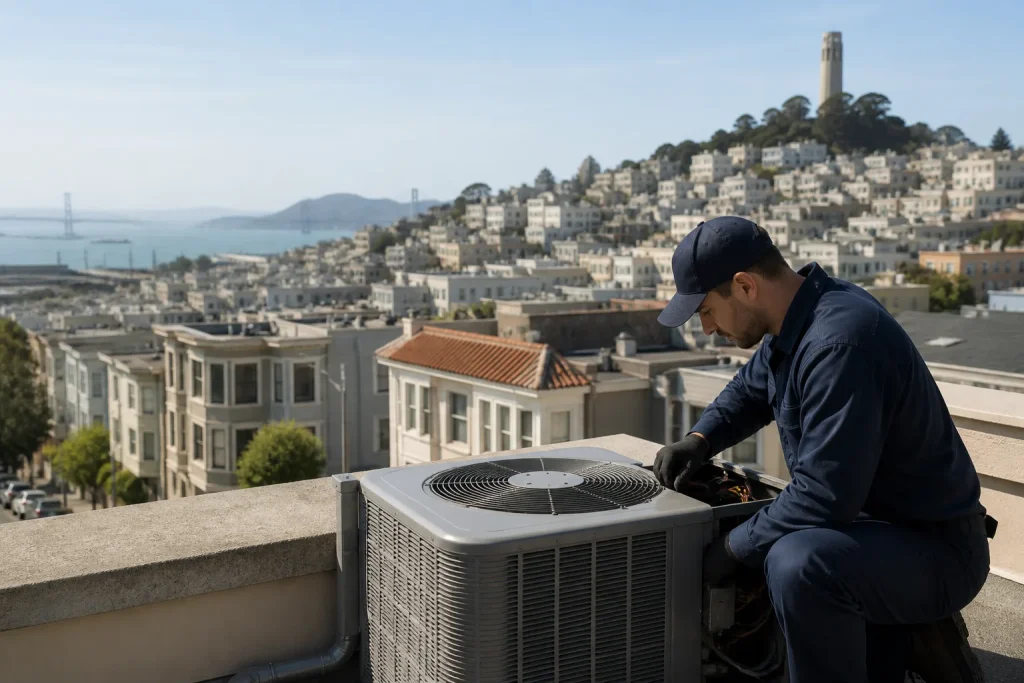
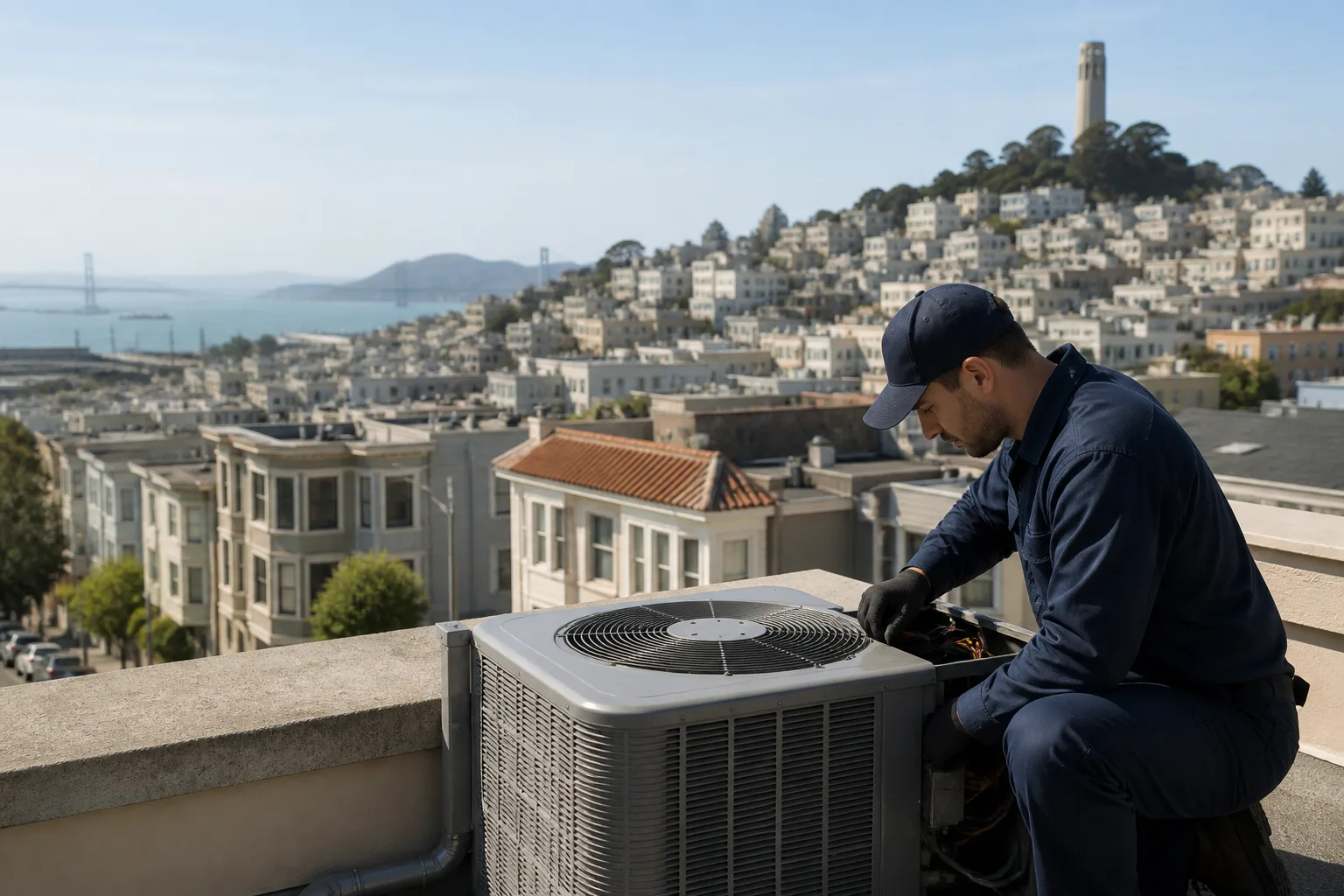
AC Repair & Installation: Repair or Replace? How San Francisco Homeowners Decide
Most San Francisco homeowners should repair their AC if the unit is under 12 years old and the fix costs under $500, but replace it if it’s an R-22 system, needs a compressor, or the repair estimate exceeds $3,000. The unique part: because San Francisco AC units run roughly 200 to 300 hours per year instead of the national average of 1,500+, a 15-year-old unit here often has the wear of an 8-year-old unit in Phoenix. If you’d rather not run the math yourself, call us at (855) 600-3322 for a free, no-pressure estimate.
Here’s the mistake we see constantly. A homeowner in the Sunset District calls us after another company told them their 14-year-old Carrier needs replacement because “that’s the lifespan.” That same unit in Houston would have 21,000 run hours on it. In San Francisco? Maybe 4,200. We’ve seen Bryant units in the Richmond last 22 years with basic maintenance because they simply don’t work that hard in our climate.
Why San Francisco AC Units Age Differently Than the Rest of the Country
National HVAC advice assumes you’re running air conditioning hard. In Arizona, Florida, or Texas, an AC unit is essentially a 6-month-per-year appliance. In San Francisco, it’s more like 6 to 10 weeks of real demand, plus a handful of scattered hot days.
This matters for your repair-or-replace calculation. We calculate “equivalent age” by estimated run hours, not just calendar years. Here’s how we break it down on jobs across the city:
- San Francisco equivalent: 250 hours/year × 15 years = 3,750 total hours
- Phoenix equivalent: 1,500 hours/year × 8 years = 12,000 total hours
- Houston equivalent: 1,400 hours/year × 9 years = 12,600 total hours
That 15-year-old unit in your Noe Valley home? It’s got less mechanical wear than many 8-year-old systems in the Sun Belt. The compressor, the capacitor, the contactor — these parts fail from use cycles and run time, not from sitting in your garage.
We serviced a Trane unit in the Marina last month, 17 years old, original compressor still running strong. The homeowner was quoted $8,500 for a full replacement by another company. We replaced a $340 capacitor and a $180 contactor. Total bill: under $600. That unit has years left because San Francisco’s cool summers simply don’t punish equipment the way inland heat does.
The Rule of 5,000 and How to Adjust It for San Francisco
The standard HVAC industry formula is simple: multiply the repair cost by the unit’s age in years. If the result exceeds $5,000, replacement usually makes financial sense.
Example: A $600 repair on a 10-year-old unit scores 6,000. That’s above the threshold, so national guides say replace.
But that formula ignores run hours. We use a San Francisco modifier: divide the age by 1.5 to 2.0 to get the “effective age” for our climate. That same 10-year-old unit becomes effectively 5 to 7 years old. Now the score is 3,000 to 4,200, well below the replacement threshold.
Here’s our adjusted guide for San Francisco homeowners:
| Repair Cost | Calendar Age | Standard Score | SF-Adjusted Score | Our Recommendation |
|---|---|---|---|---|
| $400 | 12 years | 4,800 | 2,400–3,200 | Repair |
| $800 | 14 years | 11,200 | 5,600–7,500 | Borderline — get second opinion |
| $2,500 | 10 years | 25,000 | 12,500–16,700 | Replace (compressor-level failure) |
| $350 | 18 years | 6,300 | 3,150–4,200 | Repair if no other issues |
The modifier isn’t arbitrary. We’ve tracked failure patterns across 357 service calls in San Francisco over a decade. Capacitors and contactors fail from power fluctuations and corrosion (hello, Pacific moisture), not from run hours. Compressors fail from actual use. Our climate protects the expensive parts.
When Refrigerant Type Overrides Every Other Calculation
R-22, also called Freon, changes everything. If your unit was manufactured before 2010, it probably uses this refrigerant, and EPA regulations have made it prohibitively expensive. As of 2020, no new R-22 can be produced or imported. What’s left is reclaimed stock, and prices have climbed to $150 to $250 per pound in the San Francisco market.
A typical residential system holds 5 to 10 pounds. A “simple” refrigerant recharge can run $750 to $2,500 before you even address the leak that caused the loss.
Here’s our hard rule: if your R-22 unit needs any refrigerant work beyond a minor top-off, we recommend replacement. The equipment is already past its design life, the refrigerant is a dead-end technology, and you’re throwing money at a system with zero future resale or repair value. We’ve had customers in the Mission spend $1,800 on an R-22 recharge, only to call us six months later when it leaked again.
New systems use R-410A or the newer R-32. These are widely available, reasonably priced, and compatible with modern efficiency standards. If you’re unsure what refrigerant your unit uses, the label on the outdoor condenser will state it clearly. When in doubt, snap a photo and text it to us at (855) 600-3322.
Red Flags in Repair Quotes: When to Get a Second Opinion
Here’s something the industry doesn’t like to discuss. A technician who sells both repairs and replacements has a built-in incentive to recommend the more profitable option. A $8,000 replacement pays better than a $400 capacitor swap. Most technicians are honest. Some aren’t. Here’s how to tell the difference.
We tell every customer in San Francisco to ask these questions:
- “Can you show me the failed part?” A failed capacitor is visibly bulging or leaking. A burned contactor has scorch marks. If they can’t or won’t show you, that’s a flag.
- “What’s the exact refrigerant pressure reading?” Vague claims of “low Freon” without numbers suggest upselling. We document pressures on every call.
- “Are you quoting repair and replacement, or just replacement?” Ethical technicians present both options with honest math.
- “Will you put the diagnosis fee toward the repair if I proceed?” We do. Many companies don’t, which creates pressure to accept whatever they recommend.
Daniel personally handles every diagnostic at Northstar. That means the same person evaluating your system is the one whose name is on the company. No commission structure, no sales quota, no incentive to sell you something you don’t need. We’ve walked away from replacement jobs where a $200 repair was the right call, and we’ve talked homeowners out of repairs when replacement was genuinely smarter. Our 4.9-star rating across 357 reviews exists because we treat it like our own money — because in a sense, it is.
SF Rebates and Incentives That Shift the Math
Sometimes replacement is the right call, and San Francisco has programs that make it less painful. These can flip a borderline decision toward upgrading:
- BayREN Home+: Rebates up to $1,000 for high-efficiency central AC or heat pump replacement in qualifying homes. Income-qualified households can access enhanced incentives.
- PG&E rebates: Variable by equipment efficiency tier, typically $50 to $600 for qualifying systems. Higher SEER ratings unlock more.
- TECH Clean California: Heat pump incentives that can reach $3,000 or more when converting from gas heating to electric heat pump systems. This matters for San Francisco homeowners considering dual-fuel or all-electric upgrades.
- SF PUC programs: Limited assistance for energy efficiency improvements in specific neighborhoods and income brackets.
These programs change periodically, and the paperwork isn’t trivial. We help our customers navigate them because a $2,500 rebate can turn a 12-year payback into a 7-year payback, which changes the decision. If you’re considering replacement, ask us what’s currently available — we stay current because we process these applications regularly.
One practical note: rebate-eligible equipment must be installed by a qualified contractor, and the system must meet specific efficiency thresholds. We specify Carrier and American Standard units that qualify, and we handle the submission paperwork as part of our installation service.
Key Takeaways for San Francisco Homeowners
- San Francisco AC units accumulate wear at roughly half to two-thirds the rate of national averages due to low run hours.
- Use the Rule of 5,000 with a 1.5× to 2.0× climate modifier for local repair-or-replace decisions.
- R-22 refrigerant systems are generally not worth major repairs regardless of apparent condition.
- Always ask for part verification and pressure readings before authorizing expensive work.
- Factor available rebates into replacement math; they can swing borderline decisions.
- When in doubt, get a second opinion from a technician with no sales commission structure.
The Bottom Line
The repair-or-replace decision in San Francisco isn’t about following national age guidelines. It’s about actual wear, refrigerant reality, and honest math. We’ve seen $12,000 replacements that were unnecessary and $400 repairs that were throwing good money after bad. The difference is always in the specifics of the unit, the home, and the technician’s incentive structure.
If you’re staring at a repair quote and wondering whether it makes sense, our AC repair and installation team in San Francisco will give you a straight answer. No dispatcher, no sales script, just Daniel showing up with a multimeter and a decade of experience on 9 major brands. Free estimates, no pressure. Call (855) 600-3322 or reach out through Northstar Heating & Air San Francisco home.
Frequently Asked Questions
15 to 22 years is realistic for well-maintained units in San Francisco, compared to 12 to 15 years nationally. The mild climate means compressors and major components simply don’t work as hard. We’ve serviced Trane and Bryant units in the Richmond and Sunset that crossed 20 years with basic annual maintenance. Call (855) 600-3322 if you want us to assess your specific unit’s remaining life.
Repair is almost always cheaper in the short term, but replacement wins when repairs exceed $3,000, the unit uses R-22 refrigerant, or you’re facing multiple component failures. In San Francisco’s climate, we lean toward repair for units under 14 years old with single-point failures. Get a free estimate to compare exact numbers for your situation.
Yes, we offer same-day and emergency HVAC service across San Francisco for urgent cooling failures. We prioritize calls from elderly residents, families with infants, and commercial clients with temperature-sensitive equipment. Call (855) 600-3322 and we’ll give you a realistic arrival window, not a vague “sometime today.”
Often yes, especially if your furnace is also aging. San Francisco’s moderate temperatures make heat pumps highly efficient, and heat pump and mini split systems in San Francisco qualify for rebates that traditional AC replacements don’t. We also handle heating and furnace service in San Francisco if you want to evaluate your whole system. The upfront cost runs higher, but dual heating-cooling capability and rebate stacking can deliver strong ROI.
Written by Daniel Okafor, Owner & Lead Technician at Northstar Heating & Air San Francisco, serving San Francisco since 2016.
Need HVAC Help?
Call Northstar Heating & Air San Francisco — licensed & insured, here with fast after-hours help in San Francisco.
(855) 600-3322