
Heat Pump & Mini Split: Repair or Replace? How San Francisco Homeowners Decide
Most San Francisco homeowners should replace their heat pump or mini split if annual repair costs exceed $400–$600, the unit uses phased-out R-22 refrigerant, or it’s over 12 years old with any major component failure. Our mild climate lets these systems limp along longer than national guides suggest, but that same longevity often masks the point where replacement becomes the smarter financial move. If you’d rather not run the numbers yourself, call us at (855) 600-3322 for a free, no-pressure estimate.
Here’s the trap we see constantly in San Francisco homes: a mini split in the Sunset or Richmond District keeps “working,” so the owner keeps patching it. The national “50% rule” says replace if a repair costs half the unit’s value. That rule was written for Phoenix, where heat pumps run eight months straight at 110°F, or Chicago, where they battle subzero winters. In San Francisco’s moderate climate, a system can cycle on and off gently for years past its economic death, bleeding money through efficiency loss and incremental repairs that never quite trigger that 50% threshold. We’ve pulled units out of garages in the Outer Sunset where the owner had spent $2,800 over six years on a system worth maybe $1,200 new. Each repair felt reasonable. The total never did.
Why San Francisco’s Climate Changes the Repair-vs-Replace Math
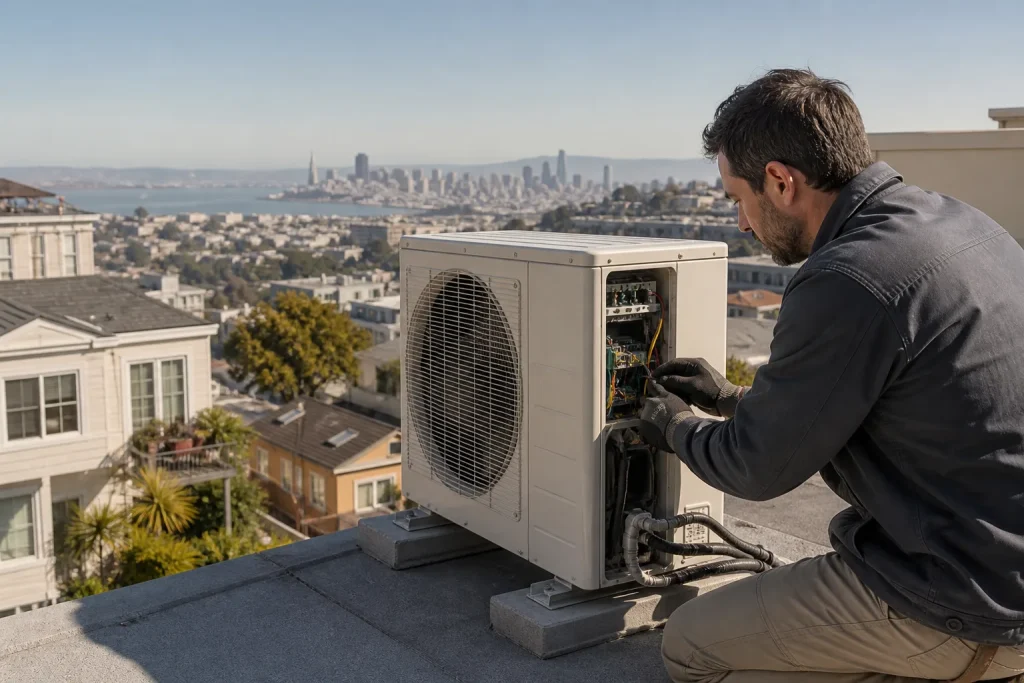
San Francisco’s weather is forgiving on paper and brutal in practice for HVAC equipment. The fog belt, stretching from the Sunset and Richmond through the Presidio and into Daly City, creates sustained humidity that central California and the East Bay simply don’t experience. That moisture penetrates outdoor compressor cabinets, corrodes electrical connections, and degrades capacitors faster than dry heat ever would.
We see this pattern repeatedly in our calls. A Daikin or Rheem mini split in the Outer Richmond looks fine from the sidewalk. Open the cabinet and the control board shows green corrosion around the relay contacts. The inverter board, which modulates compressor speed for efficiency, starts throwing intermittent faults that don’t appear during a brief service call. The owner gets a $340 capacitor replacement, then a $580 fan motor six months later, then a $920 inverter repair the following spring. Each fix is “cheaper than a new unit.” The running total isn’t.
Compare this to a similar system in Walnut Creek or San Jose. Drier air, more consistent sun, less salt-fog intrusion from the Pacific. Those units often fail more dramatically but less expensively, a single compressor death that makes the replacement decision obvious. San Francisco’s slow corrosion creates the expensive illusion of manageable problems.
Our guideline for fog-belt neighborhoods: reduce the standard 12–15 year replacement window by 2–3 years if the outdoor unit sits exposed to prevailing westerly flow. If you’re in a sheltered microclimate like Noe Valley or the Mission, standard timelines apply.
The R-22 Refrigerant Problem Nobody Talks About
If your San Francisco heat pump or mini split was installed before 2010, it likely runs on R-22 refrigerant. The EPA phased out R-22 production entirely in 2020. What’s left is reclaimed stock, imported supplies, or illegal black-market product. Prices have quadrupled since 2015, and a “simple” refrigerant recharge that cost $180 then runs $600–$900 now in the Bay Area market.
Here’s where replacement math gets brutal. A refrigerant leak in an R-22 system isn’t a one-time fix. The leak points, usually at flare connections or the evaporator coil, corrode progressively in our humid environment. We locate the leak, braze the joint, pressure-test, evacuate, and recharge. Sixteen months later, another leak develops. The owner faces the same decision again, with refrigerant costs likely higher.
We’ve stopped recommending R-22 repairs on systems over eight years old unless the leak is demonstrably isolated and accessible. The environmental regulations aren’t reversing. The refrigerant supply isn’t stabilizing. For San Francisco homeowners, an R-22 repair is often a down payment on future regret.
Modern replacements use R-410A or the newer R-32, both widely available and significantly more efficient. A 16 SEER heat pump replacing a 2008 R-22 unit typically cuts heating and cooling energy use by 30–40% in our climate, where systems run primarily in heat mode during our cool summers and mild winters.
The Cost-Per-Year Formula We Use On-Site
Homeowners deserve a number they can defend to a spouse or a landlord, not a gut feeling from a technician. Here’s the formula Daniel personally uses during consultations:
- Total invested to date: Add all repair invoices, refrigerant recharges, and maintenance costs for the past three years.
- Projected next-three-year cost: Take that same number and increase it 15% annually for systems 8–12 years old, 25% annually for systems over 12. Corrosion accelerates; compressor failure probability rises sharply.
- Replacement cost minus rebates: Get a firm installed quote, then subtract confirmed rebates (BayREN, PG&E, federal tax credits). Don’t estimate rebates; confirm them.
- Divide replacement net cost by 15: This gives your annualized replacement cost, assuming a 15-year lifespan for modern equipment in our climate.
If your projected three-year repair total exceeds the annualized replacement cost, replacement wins. Period.
Example from a recent job in Bernal Heights: homeowner had spent $1,100 over three years on a 14-year-old York heat pump. Projected next three years: $1,650. Replacement quote after BayREN and federal credits: $6,800. Annualized: $453. Projected repair cost exceeded replacement cost in under two years. They replaced. That was March 2024. We’ve had zero callbacks.
This math only works with real numbers. We provide them free. Heat Pump & Mini Split in San Francisco estimates include load calculations, rebate research, and honest projections, not sales pressure.
SF Rebates That Flip the Math Toward Replacement
San Francisco homeowners often underestimate available incentives because the landscape fragments across multiple programs. Here’s what’s active as of early 2025:
- BayREN Home+: Up to $1,000 for heat pump water heater or HVAC replacement, with additional amounts for income-qualified households. Requires post-install inspection by a BayREN-participating contractor.
- PG&E heat pump rebates: Vary by equipment efficiency tier, typically $200–$600 for ductless mini splits meeting CEE Tier 1 or higher. Must be installed by a participating contractor with AHRI-matched equipment.
- Federal 25C tax credit: 30% of project cost up to $2,000 for qualified heat pumps, extended through 2032. Requires specific efficiency thresholds (SEER2 16+, HSPF2 9+ for split systems).
The key detail competitors miss: these rebates stack. A properly documented installation in San Francisco can capture BayREN plus federal credits simultaneously, reducing a $8,500 replacement to $5,500–$6,200 net. Suddenly the “expensive” replacement costs less than two years of escalating repairs on an R-22 system.
We handle rebate paperwork as part of our installation process. Daniel verifies AHRI certification numbers before ordering equipment. We’ve seen too many homeowners lose $1,000+ because a contractor installed non-qualifying equipment or failed to submit documentation within program windows.
Mini Split Failure Signs That Mean Replace, Not Repair
Ductless mini splits fail differently than central heat pumps, and the symptoms often mislead homeowners into thinking a refrigerant recharge will solve everything. Here’s what we watch for during diagnostics:
- Inverter board faults: Error codes like U4, E6, or flashing LEDs that indicate communication failure between indoor and outdoor units. Inverter boards run $800–$1,400 installed for brands like Daikin or Bryant, and they often fail again within 2–3 years in corroded cabinets. One inverter failure in a system over 10 years old usually signals replacement.
- Repeated “low refrigerant” diagnoses without confirmed leak location: If a technician adds refrigerant twice without finding the exact leak point, they’re treating symptoms, not disease. In our humid climate, micro-leaks at flare nuts evaporate detection gas before it registers. We use electronic leak detection and nitrogen pressure testing; anything less is guessing with your money.
- Indoor unit blower noise escalation: Grinding or rattling that worsens over months indicates bearing failure in the DC fan motor. Replacement motors for wall-mounted units often require full indoor unit dismounting, with labor pushing total cost past $700. Combined with other age factors, this tips toward replacement.
- Heating capacity drop in mild weather: A heat pump that can’t maintain 68°F when it’s 45°F outside has lost significant compressor capacity. In San Francisco, where we rarely demand extreme output, this failure mode hides longer than in colder climates. By the time you notice, the compressor is often damaged beyond economical repair.
When to call a pro: If your mini split shows any two of these symptoms, or any one symptom in a system over 10 years old, get a replacement quote before authorizing repairs. We’ll give you honest numbers either way. AC Repair & Installation in San Francisco covers both repair and replacement scenarios with the same upfront pricing.
When Repair Actually Makes Sense in San Francisco
We’re not replacement evangelists. Repair wins when:
- The system is under 8 years old with a single, isolated failure (failed contactor, clogged condensate line, damaged outdoor coil from physical impact).
- The unit uses current refrigerant and has no prior leak history.
- The failure is in an easily accessible component with predictable labor scope.
- The homeowner plans to sell the property within 2–3 years and needs functional, not optimal, equipment.
We repaired a 6-year-old Rheem mini split in the Marina last month. Failed outdoor fan motor, $340 part, two hours labor, no refrigerant work, no corrosion in the electrical compartment. That’s an easy repair call. The owner will get 8–10 more years. We’d have told them the same if they called someone else.
Related services in San Francisco: If your system is part of a larger heating and cooling setup, Heating & Furnace in San Francisco covers integrated furnace and heat pump configurations we commonly see in multi-story Richmond and Sunset homes.
The Bottom Line
San Francisco’s mild climate extends equipment life but also extends the financial pain of over-repair. The decision framework is simple: factor in our humidity-driven corrosion, check your refrigerant type, run the three-year cost projection, and verify every rebate before comparing numbers. Most homeowners we consult with are surprised how often replacement wins once all variables are honest.
Key takeaways:
- The national 50% rule understates replacement value in our climate; use three-year projected costs instead.
- R-22 systems are effectively unrepairable at any reasonable price; verify your refrigerant type first.
- Fog-belt exposure accelerates corrosion; subtract 2–3 years from standard lifespan estimates for exposed outdoor units.
- Stackable rebates (BayREN, PG&E, federal) often reduce replacement cost by $2,000–$3,500.
- Inverter board failures and repeated refrigerant leaks in ductless systems are replacement signals, not repair opportunities.
If you’re running these numbers on your own San Francisco heat pump or mini split and want a second opinion, Northstar Heating & Air San Francisco home is where we start every conversation. Call (855) 600-3322 for a free estimate. Daniel personally handles the diagnostic, and you’ll get the same cost-per-year breakdown we covered here, specific to your equipment, your neighborhood’s conditions, and current rebate availability. No dispatcher, no rotating crew, just the owner with 10 years of field experience and 357 customers who’ve rated that approach at 4.9 stars.
Frequently Asked Questions
Most repairs run $180–$650 for common issues like capacitor replacement, contactor failure, or condensate pump repair. Refrigerant leaks add $400–$900 depending on refrigerant type and accessibility. Inverter board replacements for ductless systems typically cost $800–$1,400. Call (855) 600-3322 for an exact quote on your specific system, estimates are free.
Replacement is usually cheaper over a 5–7 year horizon if your system is over 10 years old, uses R-22 refrigerant, or has required more than $800 in repairs over the past three years. San Francisco’s available rebates frequently flip the math even when upfront repair costs look lower. We run the full cost-per-year calculation during our free estimates so you can see the comparison with real numbers.
10–15 years is typical, but fog-belt exposure reduces this by 2–3 years for outdoor units with inadequate shelter from Pacific moisture. Systems in drier microclimates like Noe Valley or the Mission often reach the upper end of that range. Regular maintenance, including coil cleaning and electrical connection inspection, extends lifespan measurably in our humid environment.
We offer emergency HVAC services for urgent failures, and same-day repair is often available for diagnostic-confirmed issues with parts in stock. Full replacements require permitting and equipment ordering, typically 3–7 business days in San Francisco depending on equipment availability and permit scheduling. For urgent heating or cooling needs, call (855) 600-3322 and we’ll prioritize your diagnostic.
Written by Daniel Okafor, Owner & Lead Technician at Northstar Heating & Air San Francisco, serving San Francisco since 2016.
Need HVAC Help?
Call Northstar Heating & Air San Francisco — licensed & insured, here with fast after-hours help in San Francisco.
(855) 600-3322