
Emergency & Commercial HVAC: Repair or Replace? How San Francisco Homeowners Decide
Most San Francisco commercial HVAC systems get replaced too late or repaired too many times because the decision gets made in crisis mode, not with the lease and permitting facts in hand. For residential systems, the math is simpler: age, efficiency, repair cost. For commercial properties in San Francisco, your NNN lease structure, rooftop access rights, and SF Planning Department timelines often override what the equipment manual recommends. Here’s how to get the decision right before your restaurant, retail space, or office is bleeding money on a Friday afternoon.
If your AC or heating system is down right now, call us at (855) 600-3322. Daniel personally handles emergency calls across San Francisco, and we’ll give you a straight answer on repair versus replacement after seeing your actual setup.
Why Commercial HVAC Decisions in San Francisco Are Different
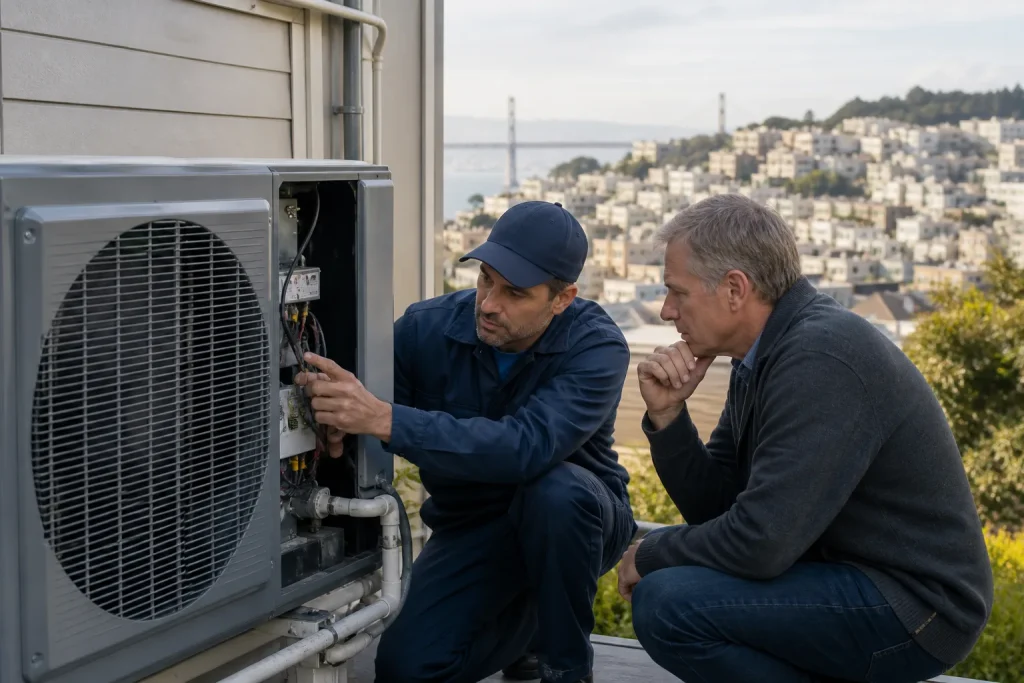
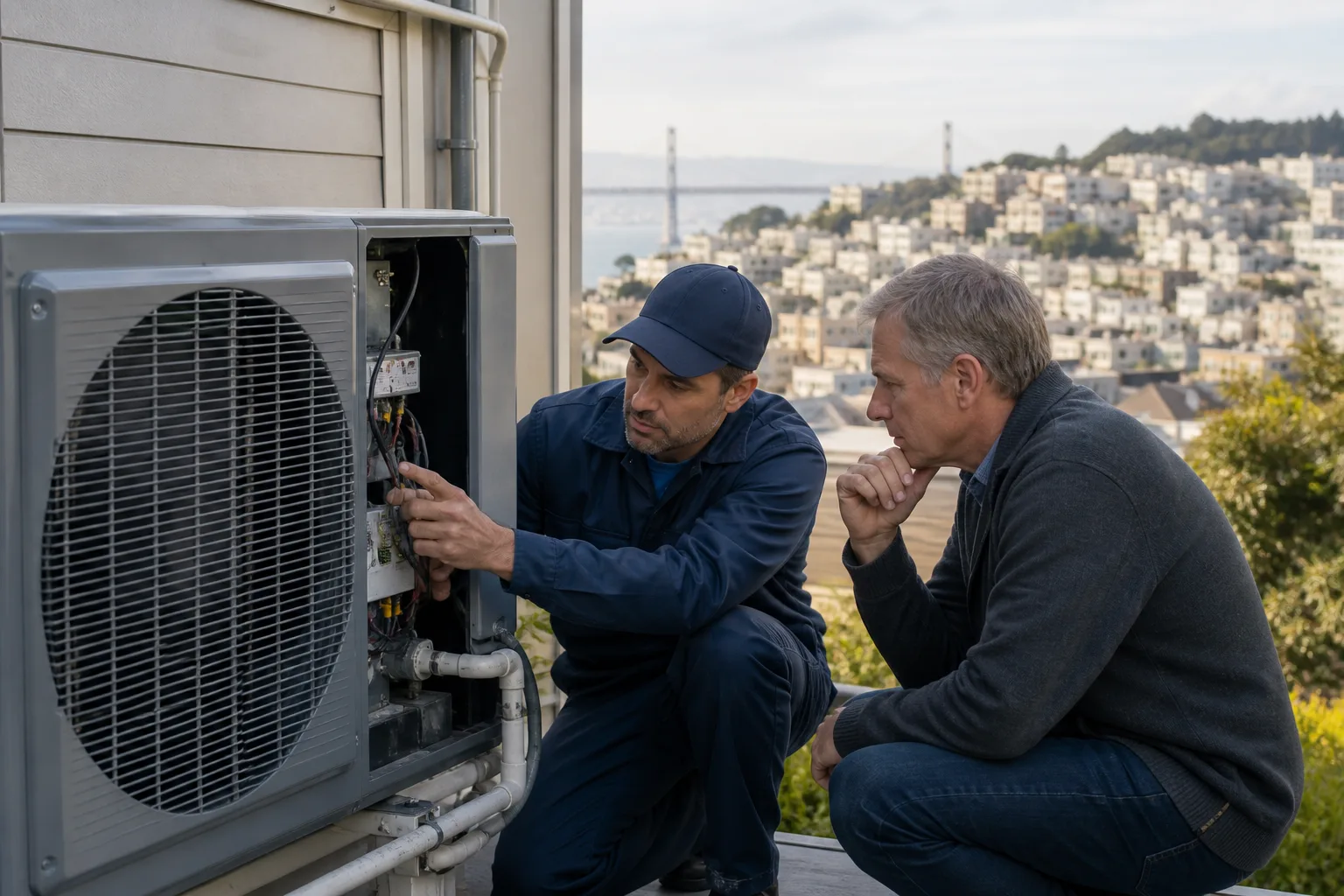
A restaurant owner in the Mission called us last month. Their rooftop RTU failed at 4 p.m. on a Friday, reservations were full, and the kitchen hood was pumping heat into a dining room that was already 78 degrees. The unit was 14 years old — past typical lifespan, technically a replacement candidate. But here’s what the equipment age didn’t tell us: SF’s commercial HVAC replacement permitting takes 3 to 6 weeks for rooftop units, and that’s before you factor in structural engineering review if the new unit weighs differently. That restaurant owner couldn’t wait. We performed a targeted compressor repair and refrigerant recharge that bought them six more months, then scheduled the full replacement during their planned August closure.
That story illustrates the core difference. In residential HVAC, the repair-or-replace calculation centers on equipment economics: repair cost versus replacement cost, factoring energy savings and remaining useful life. In San Francisco commercial properties, you layer on:
- Lease obligation structures — who actually pays for what
- Permitting and inspection timelines — measured in weeks, not days
- Business downtime costs — which often dwarf the equipment price
- Historic building constraints — limiting where equipment can even go
We’ve spent a decade doing this right across San Francisco, from SOMA tech offices to North Beach bakeries to Financial District medical suites. The same Bryant or Carrier unit fails differently depending on which roof it’s sitting on and what the lease says about who replaces it.
How Your San Francisco Lease Determines Who Pays (and Who Decides)
San Francisco’s commercial lease market runs heavily on NNN (triple net) structures, especially in mixed-use buildings in the Mission, Castro, and along Valencia Street. In a true NNN lease, tenants pay property taxes, insurance, and maintenance — including HVAC replacement. In modified gross leases, the landlord retains more obligation. Sounds simple until the unit fails and both parties are reading their copies for the first time.
We’ve arrived at emergency calls where the tenant assumed replacement was the landlord’s problem, and the landlord pointed to the NNN clause. Meanwhile, the restaurant is closed and the meter is running. Here’s what we tell San Francisco business owners before the emergency happens:
- Pull your lease now, not during the crisis. Look for “HVAC,” “mechanical systems,” or “building systems” in the maintenance and repair clauses.
- Check for capital expenditure exclusions. Some NNN leases cap tenant obligations at repair, requiring landlord approval (and often landlord-selected vendors) for full replacement.
- Document current equipment age and condition. A 12-year-old Trane RTU with two prior compressor failures is a predictable replacement. Getting landlord buy-in during stable operations beats negotiating during downtime.
- Understand your access rights. Rooftop HVAC in San Francisco often requires building management coordination for crane placement, electrical shutoffs, and sidewalk closures. Your lease may specify notice requirements that add days to any timeline.
In our experience, San Francisco tenants who know their lease terms before calling cut their decision time by half. Those who don’t often spend the first 48 hours of an emergency in negotiation, not repair.
SF Permitting Reality: What Temporary Repairs Buy You
San Francisco’s Department of Building Inspection (DBI) requires permits for commercial HVAC replacement, and rooftop units trigger additional layers: structural engineering sign-off if the new unit’s weight or dimensions change, electrical permit updates for amperage changes, and sometimes Planning Department review if the building has historic designation or visible equipment from the street.
For a standard rooftop unit replacement in a non-historic SOMA or Mission District building, we’ve seen permitting take 3 to 4 weeks with a responsive contractor and complete paperwork. Add historic review or a difficult structural question, and 6 to 8 weeks is realistic. That’s not contractor delay — that’s the city’s review queue.
This timeline is why temporary repair strategies matter so much in San Francisco commercial work. When Daniel evaluates a failing RTU on an emergency call, he’s not just asking “can we fix this?” He’s asking “can we stabilize this to buy permitting time?” Common approaches include:
- Compressor hard-start kits to extend a failing compressor’s life by weeks or months
- Refrigerant leak seal and recharge for systems with manageable leak rates
- Condenser fan motor replacement as a discrete repair on otherwise functional systems
- Control board repairs to restore operation without touching the refrigerant circuit
These aren’t permanent solutions. They’re bridge strategies that keep your San Francisco business operational while the replacement gets properly permitted. We’ve executed this exact sequence for a retail client on Fillmore Street and a dental office near UCSF. Both stayed open, both got properly permitted replacements 8 weeks later, neither paid weekend emergency replacement premiums.
The Economic Breakpoint: How Business Type Shifts the Math
The standard residential rule — “replace when repair exceeds 50% of replacement cost on a unit over 10 years” — falls apart quickly in San Francisco commercial settings. Different business types face radically different downtime costs and regulatory requirements.
Restaurants with Type I hoods: Kitchen ventilation in San Francisco requires makeup air balance. If your RTU provides that makeup air, failure doesn’t just mean discomfort — it can trigger health department operational restrictions. We’ve seen Mission District restaurants face same-day closure if hood balance can’t be maintained. The repair threshold here is “whatever keeps the hood functional today,” with replacement planned during scheduled closure.
Server rooms and tech spaces: SOMA and the eastern edge of the Financial District host dense server environments where temperature rise becomes equipment damage within hours. The economic breakpoint isn’t the HVAC cost — it’s the server replacement cost. These clients need redundant cooling or emergency portable units as part of any repair strategy.
Retail and customer-facing spaces: Comfort standards are lower than restaurants or server rooms, but foot traffic is sensitive. A 78-degree boutique in Hayes Valley loses browsers. The repair-or-replace math here weighs weekend revenue against the premium of emergency replacement versus planned.
For each scenario, we calculate total cost of downtime, not just equipment cost. A $4,000 emergency repair that keeps a restaurant open through Saturday’s reservations often beats a $12,000 planned replacement that takes 6 weeks to permit but closes you for a weekend.
Why Emergency Decisions Cost 40-60% More (and the Two-Call Strategy)
We’ve tracked this across our San Francisco commercial clients. Emergency HVAC replacement — called in on a Friday with a failed unit and desperate timeline — consistently costs 40 to 60% more than the same replacement planned and permitted normally. The premiums come from:
- Emergency labor rates for weekend and after-hours work
- Rush permitting or, worse, permit violations and later corrections
- Expedited equipment sourcing — paying premium freight for same-week delivery
- Crane and rigging surcharges for unscheduled rooftop access
- Temporary cooling/heating rentals while proper installation proceeds
The two-call strategy prevents this. Here’s how it works in practice:
Call one: The emergency call. Daniel shows up, stabilizes the system with repair, and documents the equipment for replacement. We provide a written assessment: current condition, expected remaining life, replacement specification, and estimated permitting timeline.
Call two: The planned replacement, scheduled after permits are secured and equipment is ordered. No emergency premiums. No weekend rigging. No desperate decisions.
We’ve applied this for a North Beach café and a Financial District professional services firm. Both spent less total than a single emergency replacement would have cost, and neither closed unexpectedly.
Historic Buildings: The Hidden Constraint on Every Decision
San Francisco’s historic building stock isn’t just Victorians. Significant commercial districts carry historic designation: much of SOMA’s warehouse district, portions of North Beach, stretches of the Financial District, and numerous individual landmarks. These designations constrain both repair and replacement in ways that surprise property owners.
For repairs, historic buildings often contain original or early-replacement equipment in tight mechanical spaces. We’ve sourced hard-to-find parts for aging Carrier and American Standard systems in SOMA lofts where modern replacements simply wouldn’t fit the original shaftways. The repair-or-replace decision gets made by spatial constraint, not equipment economics.
For replacement, historic review can require equipment screening, vibration isolation, or placement changes that add engineering cost and time. The new Trane or Bryant unit that drops in on a standard building becomes a custom installation with structural and aesthetic review.
If your San Francisco commercial property is in a historic district or individually designated, we recommend a pre-failure assessment that documents current equipment dimensions, available access paths, and any prior historic review determinations. This documentation shaves weeks off emergency decisions.
When to Call a Pro
If you’re staring at a failed or failing commercial HVAC system in San Francisco, and you don’t have your lease terms, current equipment age, and permitting timeline in front of you, you’re not ready to make the repair-or-replace decision. That’s not a failure — most business owners aren’t HVAC contractors. But it is the moment to call someone who can evaluate the technical condition, the business context, and the regulatory timeline together.
Daniel personally handles these assessments. We’ll tell you if a $800 repair buys you six months, or if replacement is genuinely the only rational path. No dispatcher, no rotating crew — the same technician who evaluates your system executes the work.
Related services in San Francisco: For residential and light commercial cooling needs, see our AC Repair & Installation in San Francisco page. For heating system evaluation, visit Heating & Furnace in San Francisco. For heat pump and ductless options in tight historic spaces, our Heat Pump & Mini Split in San Francisco page covers what works in constrained installations.
The Bottom Line
The repair-or-replace decision for commercial HVAC in San Francisco isn’t primarily about equipment age or efficiency ratings. It’s about lease obligations, permitting timelines, business downtime costs, and building constraints — most of which are knowable before the emergency happens.
Key takeaways:
- Know your NNN lease terms before the unit fails — who pays determines who decides
- SF commercial HVAC permitting takes 3 to 6 weeks; temporary repairs are often the smart bridge
- Business type changes the math: restaurants, server rooms, and retail each have different breakpoints
- Emergency replacement costs 40-60% more than planned — the two-call strategy prevents this
- Historic building designations add constraints that can override pure equipment economics
We’ve been owner-operated in San Francisco since 2016, with 357 customers agreeing we’ve earned our 4.9-star rating by showing up personally and giving answers that hold up. If you’re weighing repair versus replacement on a commercial or residential HVAC system, call (855) 600-3322 for a free estimate. Daniel will walk your property, review your situation, and give you the straight numbers — no pressure, no emergency premium unless it’s genuinely urgent.
Frequently Asked Questions
Commercial HVAC repair in San Francisco typically runs $800 to $4,500 depending on the component and access difficulty, while full rooftop unit replacement ranges from $8,000 to $18,000 including equipment, labor, and basic permitting. The bigger cost difference is timing: emergency replacement often adds 40-60% in premiums for expedited labor, equipment freight, and unscheduled rigging. Call (855) 600-3322 for an exact quote on your specific system — estimates are free.
Yes, same-day repair is often possible for compressor, fan motor, control board, and refrigerant issues if parts are available. Daniel carries common components for Carrier, Trane, Bryant, and American Standard systems on his service vehicle. However, same-day replacement of full rooftop units is rarely feasible in San Francisco due to permitting requirements. For emergency situations, we prioritize stabilization repairs that restore operation immediately, then plan permitted replacement during a scheduled window. Call (855) 600-3322 for emergency response.
It depends on your lease structure, business downtime cost, and San Francisco permitting timeline more than equipment age alone. A $3,500 repair on a 12-year-old unit is “expensive” in residential terms but cheap if it prevents a $15,000 emergency replacement and keeps your restaurant open through a busy weekend. We calculate total cost of ownership including downtime, not just equipment price. For a specific analysis of your system and situation, call (855) 600-3322 — we’ll run the numbers both ways.
Standard commercial HVAC replacement permitting through San Francisco DBI takes 3 to 6 weeks for rooftop units, with historic building review or structural engineering questions extending that to 6 to 8 weeks. This is why temporary repairs that buy permitting time are often the most cost-effective strategy. We handle permit submission as part of our replacement service and can provide current timeline estimates based on your specific building location and type. Call (855) 600-3322 to discuss your property’s requirements.
Written by Daniel Okafor, Owner & Lead Technician at Northstar Heating & Air San Francisco, serving San Francisco since 2016.
Need HVAC Help?
Call Northstar Heating & Air San Francisco — licensed & insured, here with fast after-hours help in San Francisco.
(855) 600-3322