
5 Mistakes to Avoid With Emergency & Commercial HVAC
Emergency commercial HVAC failures in San Francisco turn expensive not because the equipment is complicated, but because business owners make five predictable decisions under pressure that multiply repair costs by 10x or more. The most common mistake is calling the wrong type of contractor for the job, followed by skipping documentation that would have made the repair a warranty claim instead of an out-of-pocket expense. If you’re currently dealing with a failure and need immediate help, call Northstar Heating & Air at (855) 600-3322 — we handle both emergency residential and commercial HVAC across San Francisco.
We’ve been the ones taking those 6 AM emergency calls. Daniel has answered the phone to find a business owner who spent four hours making decisions that turned a $400 repair into a $6,000 replacement. Panic is expensive. A 30-minute emergency protocol prepared before the crisis hits is almost free. Here’s what we’ve learned across a decade of emergency commercial HVAC work in San Francisco.
Mistake 1: Calling a Residential HVAC Company for a Commercial Rooftop Unit
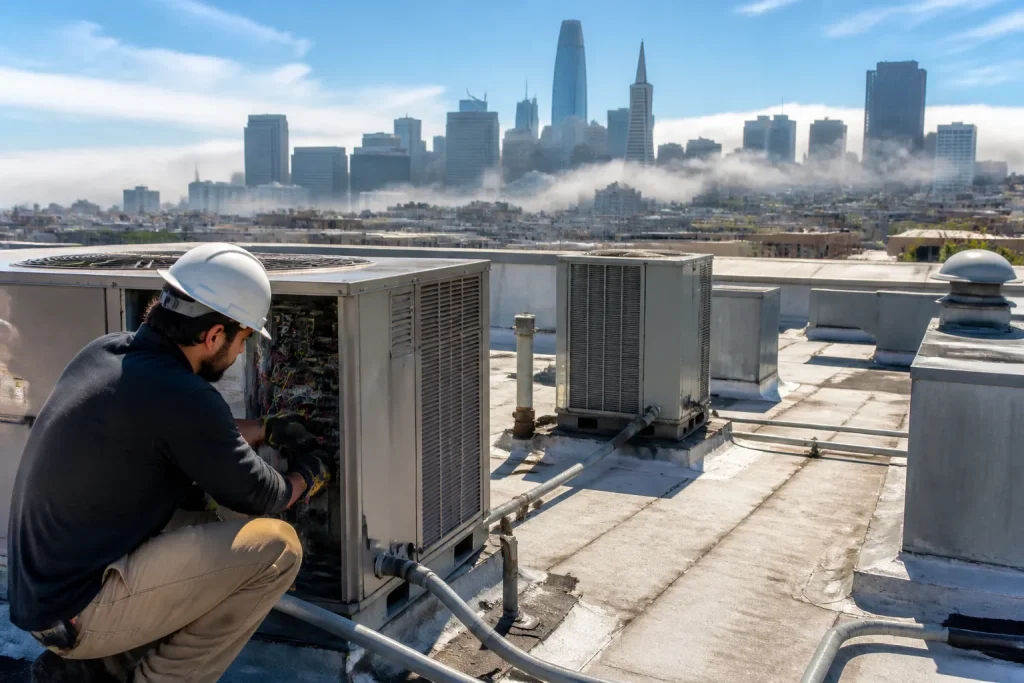
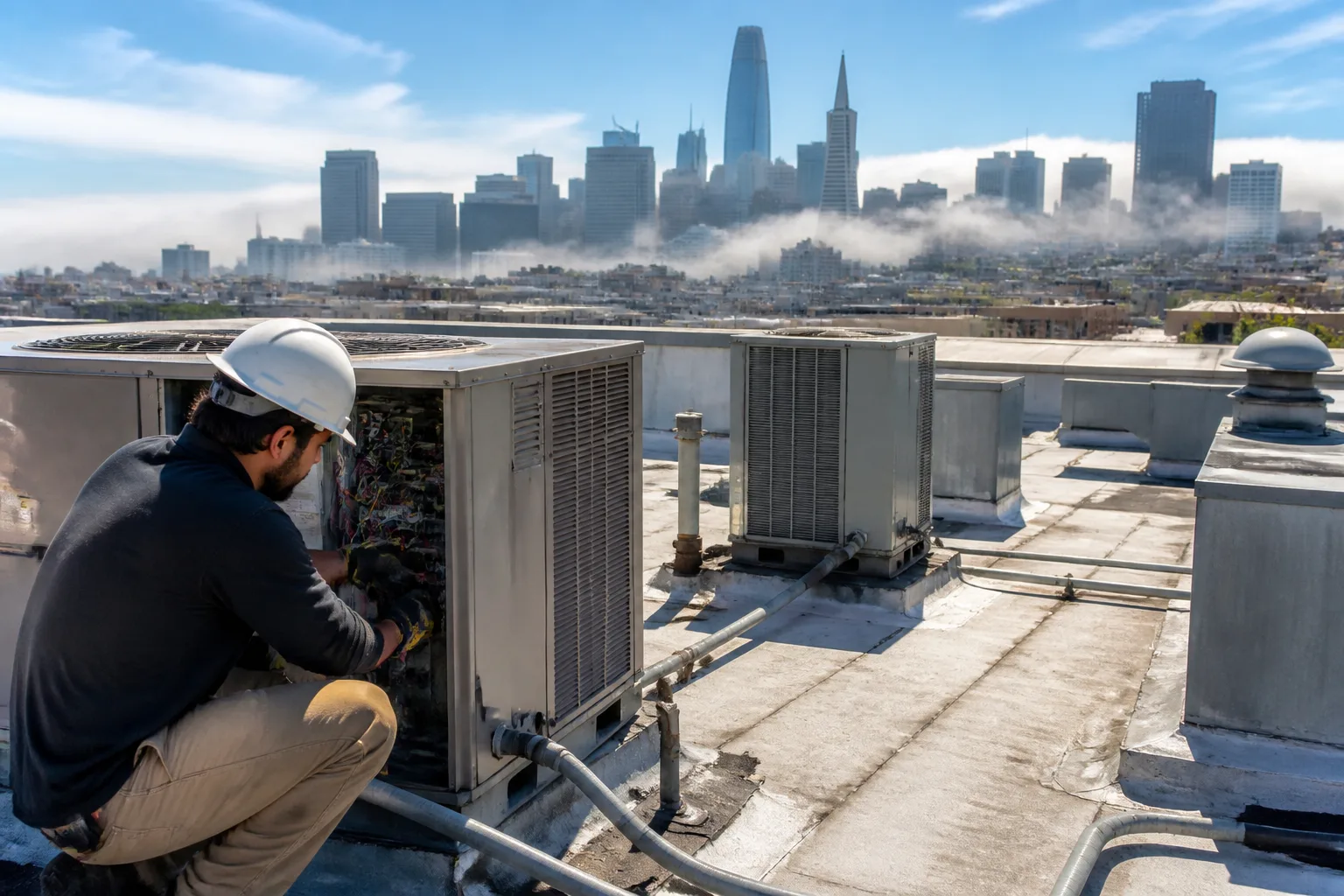
San Francisco’s building stock is dense and vertical, and commercial rooftop units aren’t just bigger versions of home systems. They’re a different category of equipment with different electrical requirements, refrigerant volumes, and access protocols. When a business owner calls a residential-only contractor for a commercial emergency, three problems stack up fast.
First, licensing. California C-20 licenses cover both residential and commercial HVAC, but many small residential shops don’t carry the liability insurance or workers’ compensation coverage that commercial property managers and SF building codes require for rooftop work above three stories. We’ve been called in after a residential contractor started the job, realized they couldn’t access the unit safely, and left the business with a half-diagnosed system and a bill for the service call.
Second, equipment access. Commercial RTUs in SOMA, the Mission, and Dogpatch often sit on parapet walls with limited crane or ladder access. Residential techs don’t typically carry the rigging knowledge or the relationships with SF equipment rental companies that commercial emergency response requires.
Third, parts availability. A residential contractor’s supply house at 7 PM won’t stock the 7.5-ton compressor or the commercial control board your York or Daikin RTU needs. We’ve got relationships with commercial distributors in South San Francisco and the East Bay that keep us moving when residential supply chains are closed.
What to do instead: Pre-qualify two commercial-capable HVAC contractors before an emergency. Verify they carry commercial liability coverage and have accessed rooftops in your specific San Francisco neighborhood.
Mistake 2: Bypassing the Thermostat and Running Systems Manually Without Logging It
When the office hits 82 degrees and the thermostat isn’t responding, someone always finds the manual override. We’ve walked into commercial spaces in the Financial District where a well-meaning facilities person has been running a 15-ton system in manual mode for three days straight.
Here’s the problem. Commercial HVAC warranties from manufacturers like Bryant and American Standard require that failures be documented through the system’s normal control sequence. When a technician arrives to find a unit that’s been hard-wired around its safety controls, the warranty claim gets complicated fast. The manufacturer can argue the failure resulted from unlogged manual operation outside design parameters.
Insurance claims get worse. If that manual operation leads to compressor burnout or electrical damage, your property insurer may deny coverage based on “unauthorized modification of equipment controls.” We’ve seen this exact scenario in a retail space near Union Square where a $3,200 repair became a fully out-of-pocket replacement because no one logged when the bypass started or who authorized it.
What to do instead: If you must bypass controls during an emergency, log the date, time, who performed the bypass, and the reason. Photograph the original wiring configuration before changing anything. Then call for emergency service immediately — don’t let manual mode become standard operating procedure.
Mistake 3: Accepting a Same-Day Emergency Replacement Quote Without Permit Verification
San Francisco’s Department of Building Inspection (DBI) requires permits for most commercial HVAC replacements, especially when electrical service changes, refrigerant line modifications, or structural roof penetrations are involved. The permit process isn’t optional, and it isn’t fast.
We’ve reviewed competitor quotes given to San Francisco business owners under emergency pressure that simply didn’t mention permits. The quote looked competitive. The equipment was specified correctly. But the $8,500 “all-in” price became $10,200 after DBI permit fees, plan review, and the expedited processing that emergency situations require. One restaurant owner in the Richmond District signed a same-day replacement quote at 5 PM on a Friday and learned Monday morning that the contractor hadn’t pulled permits and couldn’t start work for two weeks.
Verbal promises of “we’ll handle permits” aren’t enough. The permit holder of record matters for liability, and the timeline matters for your business operation. A proper emergency replacement quote in San Francisco should specify whether permits are included, who’s responsible for pulling them, and the realistic timeline for DBI approval.
What to do instead: Ask three specific questions before signing any emergency replacement quote: Is the DBI permit included in this price? Who is the permit holder of record? What’s the realistic timeline from signature to startup, including plan review?
Mistake 4: Failing to Document the Failure Mode Before the Tech Arrives
This is the mistake that turns warranty coverage into a coin flip. When a commercial HVAC system fails, the evidence of why it failed starts disappearing the moment someone resets the system, changes a filter, or cycles the power.
We arrived at a medical office in the Sunset last month where the staff had power-cycled the system four times before calling us. The error code that would have pointed to a failed variable frequency drive — a $1,200 part under warranty — was gone. Without that code, we had to diagnose from scratch, and the manufacturer required proof of the specific failure mode for warranty coverage. The documentation gap turned a warranty repair into a $2,800 diagnostic and replacement.
What to capture before touching anything:
- Photograph any error codes on the thermostat or control board display
- Note the exact time the failure started and any preceding symptoms (unusual sounds, temperature drift, cycling frequency)
- Record indoor and outdoor temperatures at the time of failure
- Photograph the unit nameplate (model, serial, manufacture date) for warranty lookup
- Document when filters were last changed and any recent maintenance
This takes four minutes. It can save thousands.
Mistake 5: Not Notifying Tenants or Employees in Writing, Exposing Cal/OSHA Liability
California workplace safety regulations under Cal/OSHA require employers to maintain indoor temperatures that don’t exceed 85°F for most indoor workspaces. When commercial HVAC fails in San Francisco’s summer — particularly in south-facing spaces in SOMA or the Mission where heat gain is concentrated — indoor temperatures can climb past this threshold within two hours.
Business owners who don’t document their response to HVAC failures can face Cal/OSHA complaints from employees or tenant claims of uninhabitable conditions. We’ve seen property managers in multi-tenant buildings receive formal complaints because tenants had no written record that the landlord was aware of the failure and taking corrective action.
Written notification doesn’t have to be formal. An email to employees or a group text to tenants stating “HVAC system failed at [time], technician called at [time], expected resolution [timeframe]” creates a contemporaneous record of reasonable response. If the failure extends past a business day, documenting alternative measures — portable cooling, adjusted work hours, temporary relocation — demonstrates good-faith effort to comply with workplace standards.
What to do instead: Send written notification within 30 minutes of discovering the failure. Include the time of discovery, the contractor contacted, and the expected timeline. Update every two hours if resolution is delayed.
When to Call a Pro
If your commercial HVAC system is blowing warm air, showing error codes, making mechanical noises it didn’t make yesterday, or simply not responding to thermostat commands, the time to call is now — not after you’ve tried three resets and a filter change. Early intervention preserves warranty coverage, reduces diagnostic complexity, and often prevents the secondary damage that makes repairs expensive.
Daniel personally handles emergency commercial calls for Northstar Heating & Air across San Francisco. With 10 years in the field and certification on 9 major brands including York, Daikin, Bryant, and American Standard, we don’t refer out or rotate unknown crews. Whether it’s an emergency call or a full system install, the same technician who diagnosed your system will be the one repairing it.
Related services in San Francisco: For businesses considering equipment upgrades or proactive replacement planning, see our AC Repair & Installation in San Francisco and Heating & Furnace in San Francisco pages. For properties evaluating heat pump or ductless options, our Heat Pump & Mini Split in San Francisco coverage explains what works in San Francisco’s specific climate and building types.
The Bottom Line
Commercial HVAC emergencies in San Francisco don’t have to become financial emergencies. The five mistakes above share one root cause: decisions made without a pre-built protocol. Spend 30 minutes this week identifying your commercial-capable contractor, locating your equipment documentation, and drafting a simple notification template. When the failure happens — and in a decade of San Francisco HVAC work, we’ve never seen a system that didn’t eventually fail — you’ll be responding instead of reacting.
Northstar Heating & Air serves commercial and residential customers across San Francisco with emergency response, system replacement, and ongoing maintenance. If you’re building your emergency protocol or dealing with a failure right now, call (855) 600-3322 for a free estimate. Daniel answers the phone personally on emergency calls.
Frequently Asked Questions
Response times vary by contractor and time of day, but true commercial emergency capacity means a technician with commercial tools and parts access, not just a dispatcher answering the phone. At Northstar Heating & Air, we aim for same-day response on commercial emergencies called in before 2 PM, and we’re transparent about realistic arrival windows when after-hours calls come in. Call (855) 600-3322 to check current availability — estimates are free.
Replacement becomes the better financial decision when repair costs exceed 40% of replacement cost and the system is past 75% of its expected lifespan. For commercial RTUs in San Francisco’s salt-air environment, that threshold often arrives sooner than inland climates due to accelerated coil and cabinet corrosion. We evaluate each system on actual condition, not just age, and we’ll show you the math both ways. Call (855) 600-3322 for an honest assessment.
Most repairs — compressor replacement, control board swaps, refrigerant leaks — don’t require DBI permits. Replacements, electrical service upgrades, and any work affecting structural roof elements do. The critical point is that your quote should specify permit responsibility clearly, not bury it in fine print or omit it entirely. If you’re evaluating quotes and permit language is vague, that’s a red flag. Call (855) 600-3322 and we’ll walk you through what’s required for your specific situation.
Technically any C-20 licensed contractor can, but practical capability varies enormously. Commercial RTUs require different refrigerant handling certifications, heavier lifting equipment, and relationships with commercial parts distributors that many residential-focused shops don’t maintain. We’ve been called to fix jobs started by residential contractors who didn’t realize the scope until they were on the roof. For commercial work in San Francisco, verify actual commercial experience, not just license classification. Call (855) 600-3322 — we’ve been handling commercial RTUs across the city since 2016.
Written by Daniel Okafor, Owner & Lead Technician at Northstar Heating & Air San Francisco, serving San Francisco since 2016.
Need HVAC Help?
Call Northstar Heating & Air San Francisco — licensed & insured, here with fast after-hours help in San Francisco.
(855) 600-3322