
5 Mistakes to Avoid With Air Quality & Ventilation
The five costliest air quality mistakes in San Francisco homes all share one trait: they’re invisible until the damage is done. Most homeowners here spend between $800 and $3,000 on purifiers, monitors, or ventilation upgrades that never perform as promised because of installation errors, mismatched equipment, or fundamental misunderstandings about how air actually moves through our city’s unique housing stock. If you’d rather have someone assess your system directly, Northstar Heating & Air San Francisco offers free estimates — call (855) 600-3322.
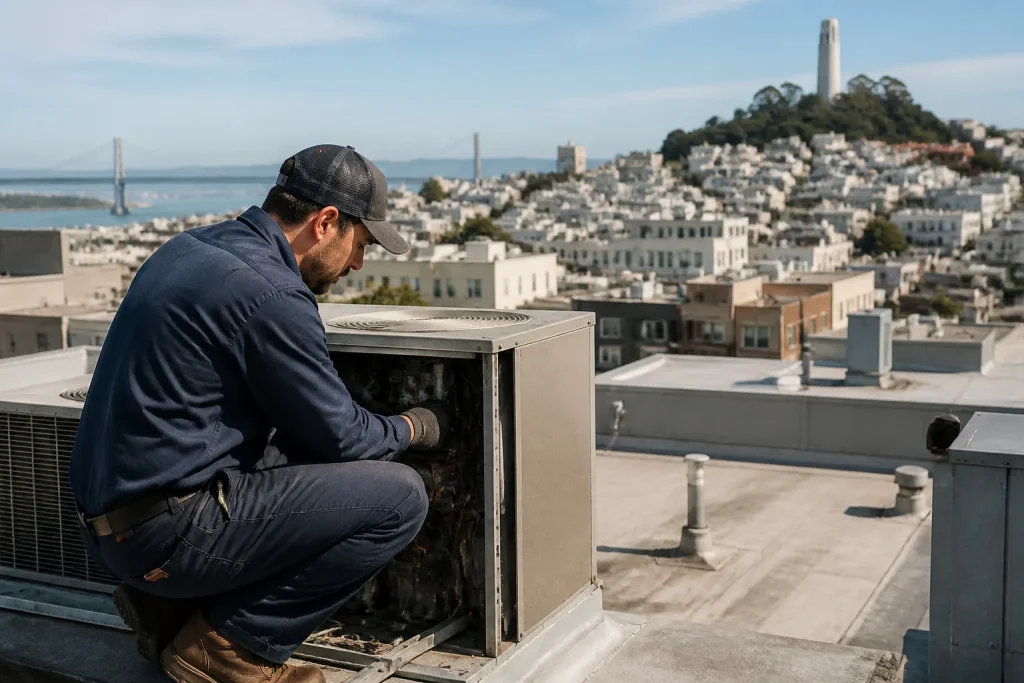
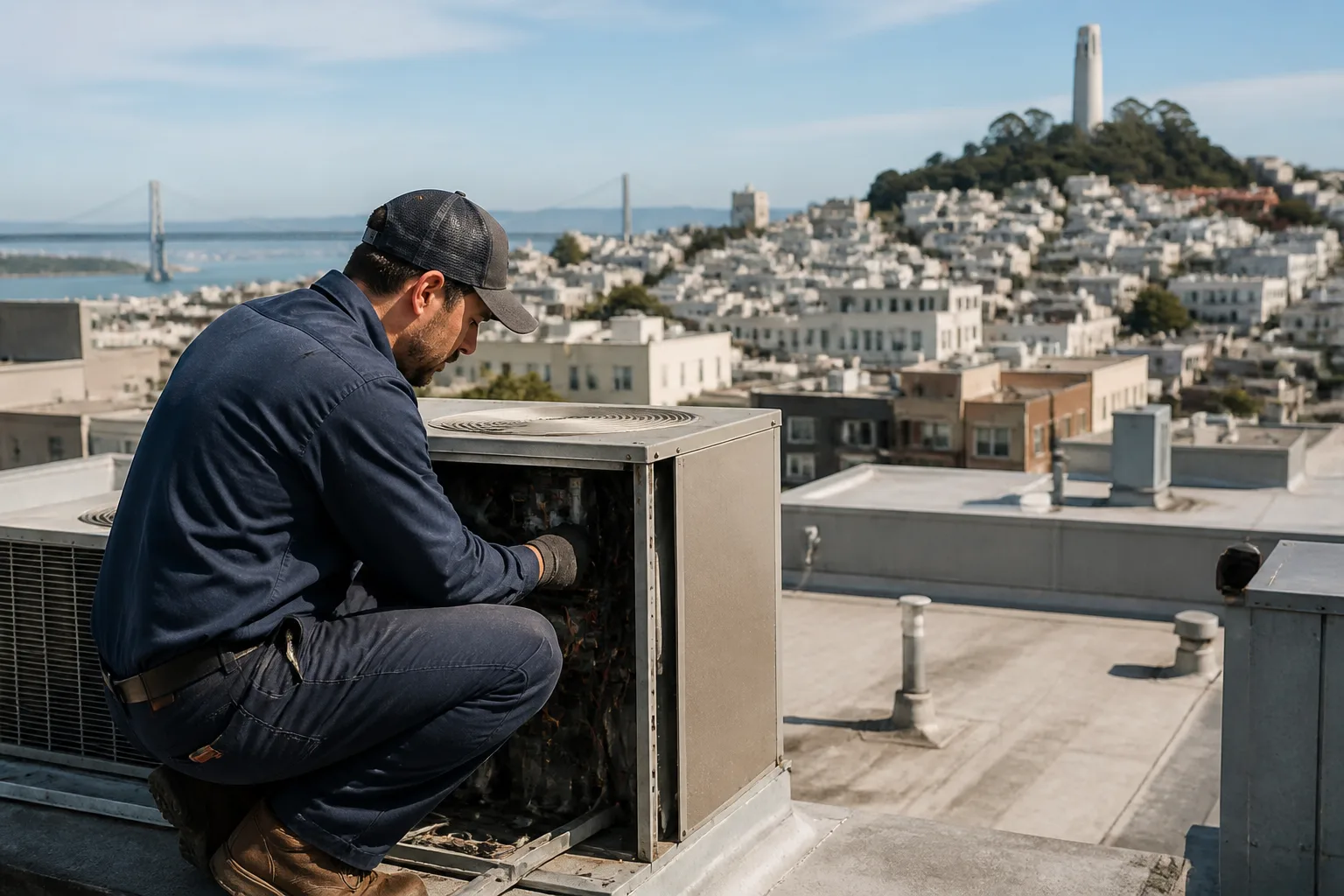
Daniel here. After ten years crawling through attics in the Mission, Pacific Heights, and the Richmond, I’ve learned that San Francisco’s housing stock — Victorians with balloon framing, Edwardian flats with no original ductwork, mid-century condos with retrofit nightmares — creates air quality problems you won’t find in a suburban manual. The most expensive mistake I see isn’t buying the wrong unit. It’s buying the right unit and installing it on a duct system guaranteed to make it fail.
Mistake 1: Installing a Whole-Home Purifier on Leaky Ductwork
Here’s a number that should stop every San Francisco homeowner: in the older homes we service — and that’s most of the city built before 1960 — duct leakage rates routinely measure 25% to 40%. That means nearly half the air your HVAC system conditions never reaches your rooms. It escapes into wall cavities, crawl spaces, and the gaps between floors that are standard in balloon-framed Victorians.
When you bolt a $1,500 whole-home air purifier onto that system, you’re treating air that immediately leaks out untreated. The purifier runs. The fan spins. Your energy bill climbs. And the particulate count in your bedroom barely shifts because the clean air never arrives.
We measured this last spring in a Noe Valley home with a brand-name UV purifier. The homeowner had spent $2,200 on installation. Duct leakage? Thirty-two percent. The purifier was working overtime to clean air that was exiting through a fist-sized gap above the bathroom ceiling. We sealed the ducts first, then re-tested. Particulate reduction improved by 4x with the same unit.
What to do instead: Test before you treat. A proper duct leakage test costs less than most purifiers and tells you whether your infrastructure can support the equipment you’re considering. In San Francisco’s older housing, this step isn’t optional — it’s the difference between performance and placebo.
Mistake 2: Confusing Air Purification With Ventilation
This one kills me because it’s so understandable. You buy a HEPA-rated portable unit for $400. You run it during wildfire season. The smoke stays out. You breathe easier. Problem solved.
Except it isn’t. A portable HEPA unit recirculates and filters the same indoor air. It does not bring in fresh air. And in San Francisco’s tightly built homes — especially the stucco-over-redwood flats in the Sunset and Richmond where every window was replaced with vinyl in the 1990s — that recirculated air gets stale fast.
During the 2020 wildfire season, we visited a home in the Inner Richmond where the owners had been running three portable HEPA units for three days with windows sealed. CO2 levels measured 2,400 ppm. That’s the cognitive impairment zone — headaches, drowsiness, poor decision-making. The HEPA units were doing their job on particulates. But no one had considered what happens when you filter the same air indefinitely without exchanging it.
Ventilation means bringing in outside air, conditioning it, and exhausting stale air. Purification means cleaning what you’ve got. Wildfire season in San Francisco demands both. A portable HEPA unit without mechanical ventilation is half a solution, and the half you’re missing becomes dangerous during extended smoke events.
What to do instead: Pair your filtration with controlled ventilation. Heat recovery ventilators (HRVs) or energy recovery ventilators (ERVs) bring in fresh air without the energy penalty of opening a window. For San Francisco’s mild climate, an ERV often makes more sense than an HRV because it manages humidity transfer too.
Mistake 3: Ignoring Kitchen and Bath Exhaust
The single biggest source of indoor humidity loading in San Francisco’s Victorian and Edwardian flats isn’t the weather — it’s cooking and showering in homes with inadequate or non-functional exhaust. I’ve lost count of the air quality assessments we’ve done where the homeowner spent thousands on whole-home solutions while their 1980s range hood vented directly into the cabinet above it.
Here’s how this mistake compounds. Humidity from cooking and bathing migrates into wall cavities through the same gaps that leak your conditioned air. In San Francisco’s fog-cooled climate, those cavities often sit below dew point. Condensation forms. Mold follows. Now your air quality problem is structural.
We see this pattern repeatedly in the multi-unit buildings in the Mission and Bernal Heights, where original exhaust was never designed for modern cooking loads and retrofits were done cheaply. The upstairs neighbor’s bathroom fan that vents into the attic doesn’t just fail to remove moisture — it pressurizes the attic and drives that moisture into your ceiling.
What to do instead: Verify where your kitchen and bath exhaust actually terminates. It should reach outside, not into attics, soffits, or interior spaces. If you’re investing in whole-home air quality, budget for proper exhaust as part of the same project. The AC repair and installation team at Northstar always includes exhaust assessment in our San Francisco air quality evaluations.
Mistake 4: Buying Smart Monitors Before You Understand What They Measure
The $200 smart thermostat with CO2 and VOC sensors looks compelling. The app is beautiful. The graphs are satisfying. But I’ve sat with too many San Francisco homeowners who can tell me their CO2 peaked at 1,847 ppm yesterday and have no idea what that number means or what action it should trigger.
CO2 sensors measure occupancy and ventilation adequacy. High CO2 means you’re under-ventilated for your occupancy. The response is more fresh air, not more filtration. VOC sensors measure volatile organic compounds — off-gassing from furniture, cleaning products, cooking. The response is source control (remove the emitter) plus ventilation, not necessarily purification.
These are different problems with different solutions. A homeowner who sees a CO2 spike and responds by cranking up their HEPA purifier has made a category error. The purifier doesn’t remove CO2. It just uses more electricity while the room gets stuffier.
Smart monitors are valuable tools. But they’re diagnostic instruments, not solutions. Buying one before you understand the ventilation-filtration-source control hierarchy is like buying a blood pressure monitor before you know what hypertension means.
What to do instead: Learn the basics of what each sensor measures and the specific response it demands. Or hire someone who does. A decade of doing this right has taught us that the best monitor is worthless without an action plan tied to its readings.
Mistake 5: Running Cheap Filters With Expensive Air Quality Equipment
This one is pure economics, and it’s painful every time I see it. Homeowner installs a $1,200 UV air treatment system. Keeps running MERV-8 pleated filters. The UV system is designed to neutralize biological growth on the coil and in the airstream. But the MERV-8 filter is letting through enough particulate load that the coil stays dirty, the UV lamps foul faster, and the system never reaches its designed performance.
We’ve pulled UV systems out of San Francisco homes where the lamps were rated for 9,000 hours but failed at 4,000 because the particulate loading was so high. The homeowner thought they were maintaining the system. They were slowly suffocating it.
The filter is the foundation. Everything else builds on it. For homes with air quality equipment, we typically recommend MERV-11 minimum, MERV-13 where the system can handle the static pressure. (Some older San Francisco furnaces can’t — that’s another assessment we do before recommending upgrades.) Brands like Carrier and Trane design their systems with specific filter requirements. Ignore them and you’re throwing away the equipment investment.
What to do instead: Match your filter to your equipment specifications, not to what’s cheapest at the hardware store. If you’ve added UV, electronic air cleaners, or advanced ventilation, step up your filtration game too. The heating and furnace specialists at Northstar can verify whether your existing blower can handle the pressure drop of a higher-MERV filter.
When to Call a Pro
If you’ve read this far and you’re now wondering whether your own system has any of these problems, that’s the right instinct. Most of these mistakes aren’t visible to a homeowner without testing equipment. Duct leakage requires a blower door and manometer. CO2 levels need a calibrated meter. Filter pressure drop needs a manometer reading across the filter rack.
We offer free air quality assessments in San Francisco that cover all five of these areas. Daniel personally handles the evaluation, not a trainee with a clipboard. You’ll get actual measurements, not a sales pitch.
Related services in San Francisco: Heat pump and mini split installation for homes without ductwork, plus full ventilation and air quality system design.
The Bottom Line
San Francisco’s housing stock — old, tight, often poorly ventilated by original design — creates air quality challenges that equipment alone can’t solve. The five mistakes above share a common thread: they treat air quality as a product purchase rather than a system integration problem. The homeowners who get this right test first, match components to actual conditions, and understand that ventilation, filtration, and source control work as a team.
Key takeaways:
- Test duct leakage before adding whole-home purification — 25-40% leakage is common in older San Francisco homes
- Portable HEPA units don’t ventilate — extended wildfire use without fresh air exchange raises CO2 to problematic levels
- Kitchen and bath exhaust must terminate outside, not into attics or cabinets
- Smart monitors are diagnostic tools — know what each sensor measures and what response it requires
- Upgrade your filter when you upgrade your air quality equipment — MERV-8 strangles expensive systems
If you’re in San Francisco and want to stop guessing about your indoor air quality, Northstar Heating & Air San Francisco offers free estimates. Daniel Okafor will assess your system personally. Call (855) 600-3322.
Frequently Asked Questions
Duct sealing typically runs $800 to $2,200 depending on accessibility and the extent of leakage. Homes with crawl spaces or attics are easier to seal than those with ducts buried in plaster walls. The investment usually pays back in 2-4 years through reduced energy bills, plus your air quality equipment finally works as designed. Call (855) 600-3322 for an exact quote on your San Francisco home — estimates are free.
During mild weather in San Francisco, yes — windows work. During wildfire season, no. Opening windows when AQI exceeds 100 defeats your filtration entirely. Mechanical ventilation with filtration on the intake side gives you fresh air without the smoke. An ERV or HRV with MERV-13 pre-filtration is the standard we recommend for Bay Area homes.
No. MERV-13 captures more particles than MERV-8, but it also creates more resistance to airflow. Some older furnaces — common in San Francisco’s pre-war housing — lack the blower capacity to overcome that resistance. The result is reduced airflow, frozen coils in cooling mode, or overheated heat exchangers in heating mode. We test static pressure before recommending filter upgrades. Nine major brands, one company — we know the specifications for Carrier, Trane, Lennox, and Goodman systems commonly found in the city.
Outdoor air runs about 400 ppm CO2. Indoors, 600-1,000 ppm is typical and acceptable. Above 1,000 ppm, you may notice drowsiness or stuffiness. Above 2,000 ppm, cognitive performance measurably declines. If your smart monitor consistently shows readings above 1,000 ppm with normal occupancy, you need more ventilation — not more purification. We can measure this accurately and design a solution for your specific San Francisco home.
Written by Daniel Okafor, Owner & Lead Technician at Northstar Heating & Air San Francisco, serving San Francisco since 2016.
Need HVAC Help?
Call Northstar Heating & Air San Francisco — licensed & insured, here with fast after-hours help in San Francisco.
(855) 600-3322