
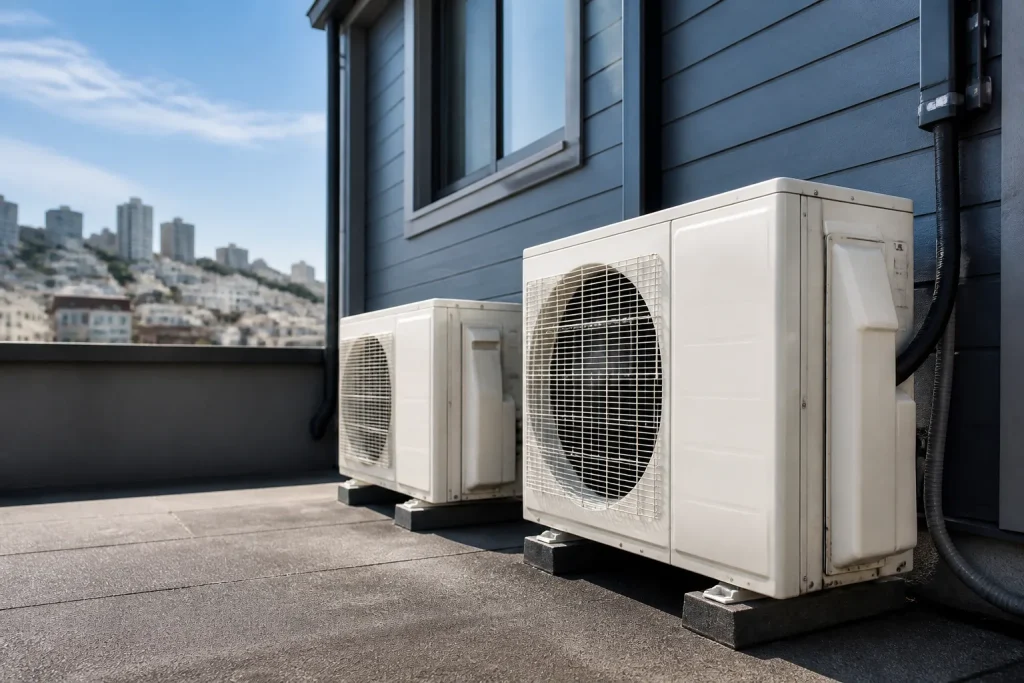
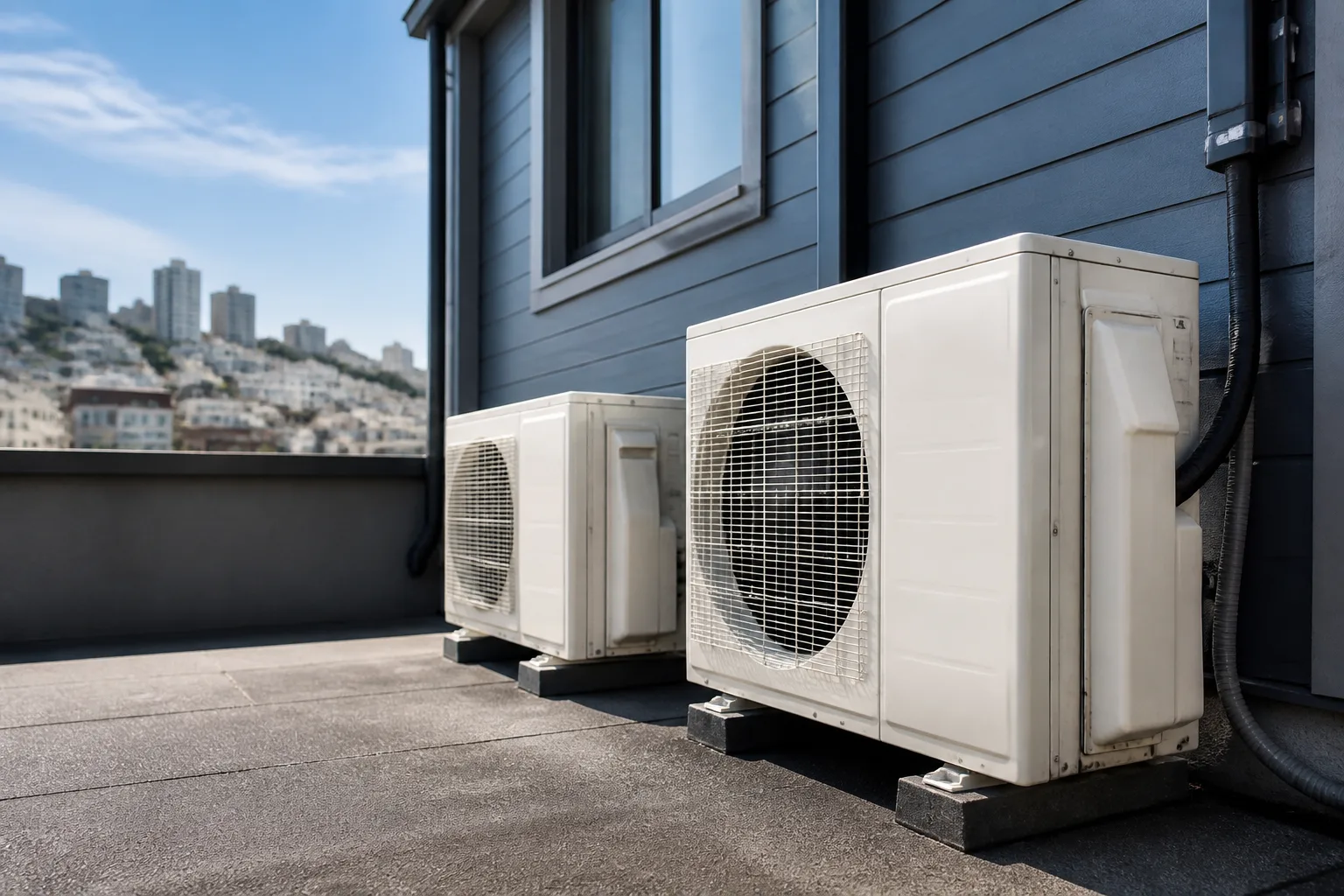
5 Mistakes to Avoid With Heat Pump & Mini Split
The five costliest heat pump and mini split mistakes in San Francisco aren’t about forgetting to change filters. They’re about salt air corrosion on outdoor units, Victorian floor plans that defeat single-zone systems, electrical surprises, permit traps in rent-controlled buildings, and a thermostat setting that quietly doubles your energy bill. We’ve fixed all of them. If you’d rather not learn the hard way, call (855) 600-3322 for a free estimate.
Daniel has walked into San Francisco homes where a mini split was professionally installed — permits pulled, equipment correct — and still failed within three years. The mistakes weren’t visible at installation. They were decisions made before the crew ever arrived. After a decade of owner-led service calls across the city, from the Sunset to SoMa, here are the five errors that actually cost homeowners money.
1. Installing the Outdoor Unit on a West-Facing Wall Exposed to Salt Fog
San Francisco’s marine layer isn’t just fog. It’s salt-laden, and it eats unprotected condensers for breakfast. We’ve replaced Daikin outdoor units in the Outer Richmond that looked ten years old after thirty-six months. The homeowner never knew the installer had options.
Here’s what happens: prevailing westerlies carry Pacific moisture inland, and when that moisture carries dissolved salt, it settles on coil fins and electrical connections. Galvanic corrosion accelerates. The unit doesn’t fail dramatically. It just loses capacity, runs longer, and dies young.
What we do differently on heat pump and mini split jobs in San Francisco: assess the microclimate of your specific block. Sometimes that means a protective louvered screen. Sometimes it means relocating the outdoor unit to a north-facing alcove, or specifying a coastal-grade coating from the factory. Bryant and American Standard both offer enhanced corrosion protection, but you have to ask for it at specification — not after the unit’s on your wall.
The mistake isn’t buying the wrong brand. It’s assuming any outdoor unit can live anywhere on your property.
2. Choosing a Single-Zone System for a Two-Story Victorian
Balloon-frame construction is San Francisco’s original sin for HVAC. Those continuous wall cavities from foundation to attic? They act like chimneys. Heat rises, sure, but in a Victorian, it rockets upward while the first floor stays stubbornly cold.
We get calls every October from Noe Valley and the Haight. Homeowner installed a single-zone mini split on the main floor last year. Now the upstairs bedroom is 78 degrees and the living room is 64. The system “doesn’t work.” Actually, it’s working exactly as physics demands. It’s just the wrong system for the building.
A single-zone mini split has one indoor head and one outdoor unit. It conditions one space. In an open-plan loft, fine. In a 1905 Victorian with original plaster and no insulation in the walls? You’re asking one wall-mounted unit to fight a hundred years of convective airflow patterns.
What works: multi-zone systems with heads on each floor, or a ducted mini split that uses existing (or new) duct paths. Yes, it costs more upfront. We’ve seen too many San Francisco homeowners pay for the single-zone install, then pay again to fix it. Daniel’s advice: measure twice, zone once.
3. Skipping the Electrical Panel Assessment
This one stings. Homeowner picks a system, schedules install, crew arrives — and discovers the 100-amp panel from 1972 can’t handle the additional load. Now you’re looking at a service upgrade, PG&E coordination, and a three-week delay. In San Francisco, that panel upgrade can run $3,000–$6,000, and it’s not optional.
We check this on every estimate. It’s not glamorous. Customers don’t want to hear about bus bars and load calculations. But we’ve seen too many jobs derailed by this surprise. Last month in the Mission, we quoted a mini split replacement and caught a Federal Pacific panel that the homeowner didn’t even know was a known fire hazard. Changed the whole scope, and probably prevented something worse.
The fix is simple: any reputable technician should verify your panel capacity before the unit goes on order. If they don’t, ask why. If they can’t answer clearly, that’s your signal. At Northstar, Daniel handles this personally — it’s part of why we show up as owner and lead technician, not a sales rep with a tablet.
4. Misreading Permit Requirements in Rent-Controlled Buildings
San Francisco’s permit system for mini splits has a quirk that catches even experienced contractors: work in rent-controlled buildings, or buildings that could be subject to rent control, triggers additional scrutiny. Not the equipment permit itself — that’s straightforward DBI. It’s the downstream effects.
Install a mini split in a tenant-occupied unit, and you’ve made a “capital improvement” that may affect rent calculations. Get the permit wrong, or skip the tenant notification requirements, and you’re in Housing Court, not just DBI appeals. We’ve been called in to fix jobs where the original installer vanished and the landlord is holding a violation notice.
Our process: verify occupancy status, confirm permit pathway, document everything. It’s slower than just drilling holes and hanging units. But a decade of doing this right in San Francisco means we’ve learned which corners aren’t worth cutting. If you’re a landlord or property manager, this isn’t DIY territory. The cost of getting it wrong far exceeds any install savings.
5. Leaving the Thermostat on “Auto” Year-Round
This is the single biggest efficiency leak Daniel sees, and it’s the easiest to fix. San Francisco’s climate tricks people. Summer days hit 72, nights drop to 52. The thermostat in “auto” mode switches between cooling and heating, sometimes within the same day. Every mode switch wastes energy. The system never settles into efficient operation.
Worse: in shoulder seasons, auto mode can trigger cooling when you actually need gentle heating, or vice versa. Your mini split works harder, cycles more, and wears faster. We’ve pulled maintenance records on three-year-old systems that have more runtime hours than seven-year-old systems in manual mode.
Our recommendation for San Francisco: use “heat” mode proactively from October through May, even if you occasionally need to crack a window. Use “cool” mode only when sustained warmth demands it. The “dry” mode on most systems — Daikin and Carrier both do this well — handles muggy days without full cooling. Auto mode isn’t smart; it’s indecisive, and indecision costs money.
When to Call a Pro
If you’re planning a new mini split or heat pump install, or if your existing system isn’t performing, the inspection matters more than the brand. We’ve seen AC repair calls in San Francisco that were really electrical problems, and heating service calls that were really zoning failures. The common thread: someone skipped the assessment.
Related services in San Francisco: Heat Pump & Mini Split in San Francisco
The Bottom Line
Most mini split mistake guides recycle filter-cleaning advice. The real money-losers are specific to where you live — San Francisco’s salt air, Victorian bones, aging electrical infrastructure, tenant protection laws, and deceptive climate. Avoid these five, and your system will last closer to its designed lifespan.
Key Takeaways:
- Protect outdoor units from west-facing salt exposure, or specify coastal-grade equipment
- Match zoning to your building’s construction — single-zone rarely works in multi-story Victorians
- Verify electrical panel capacity before ordering equipment
- Understand permit and tenant-notification requirements in rent-controlled buildings
- Use manual heat/cool modes, not auto, for San Francisco’s variable climate
If you’re in San Francisco and need help assessing your situation, Northstar Heating & Air San Francisco offers free estimates. Daniel Okafor handles every job personally. Call (855) 600-3322.
Frequently Asked Questions
With proper installation and protection from salt corrosion, 15–20 years is typical. We’ve seen unprotected coastal units fail in 8–10. The marine layer is the variable most installers underestimate. Call (855) 600-3322 if you want us to assess your specific exposure.
Repair usually makes sense if the unit is under 10 years and the fix is under $1,000. Beyond that, replacement efficiency gains often pay back within 3–5 years, especially with San Francisco’s high electricity rates. We don’t recommend replacement unless the math works — call (855) 600-3322 for an honest assessment.
Yes, but it requires planning. Historic designation doesn’t prohibit mini splits, but it affects placement of outdoor units and line-hide routing. We’ve installed in designated landmarks — the key is early coordination with DBI and, when relevant, preservation staff. Daniel handles this personally; call (855) 600-3322 to discuss your building.
Most commonly, it’s defrost cycle operation, which is normal in cold, humid conditions. If it persists beyond 10–15 minutes, possible causes include refrigerant charge issues, failed reversing valve, or a stuck sensor. Don’t force the system — shut it down and call (855) 600-3322. Running it hard while malfunctioning can damage the compressor.
Written by Daniel Okafor, Owner & Lead Technician at Northstar Heating & Air San Francisco, serving San Francisco since 2016.
Need HVAC Help?
Call Northstar Heating & Air San Francisco — licensed & insured, here with fast after-hours help in San Francisco.
(855) 600-3322