
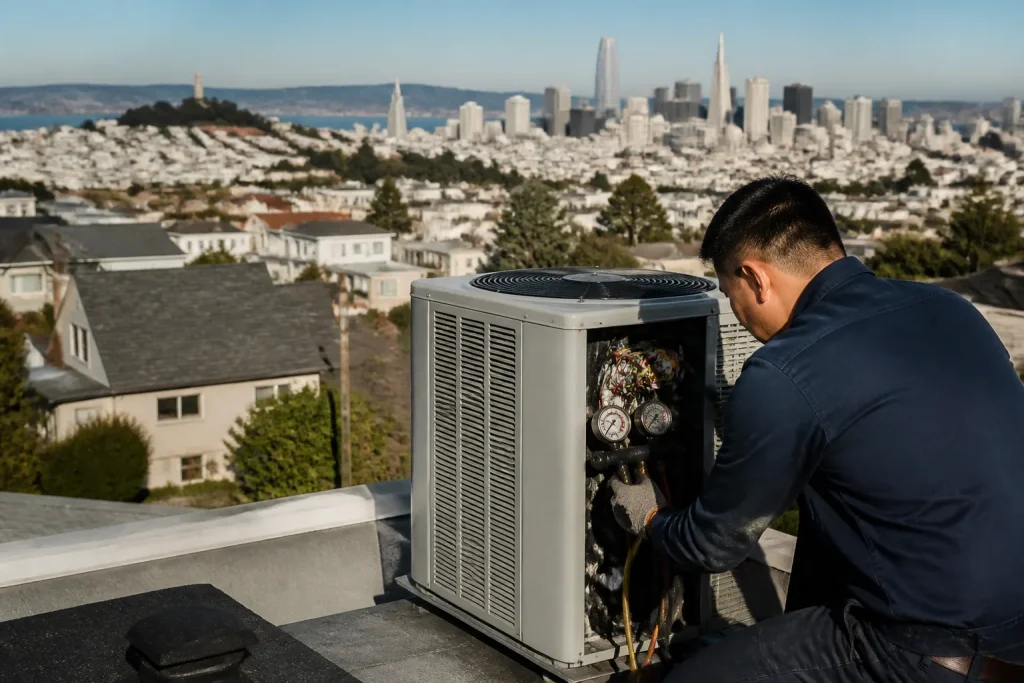
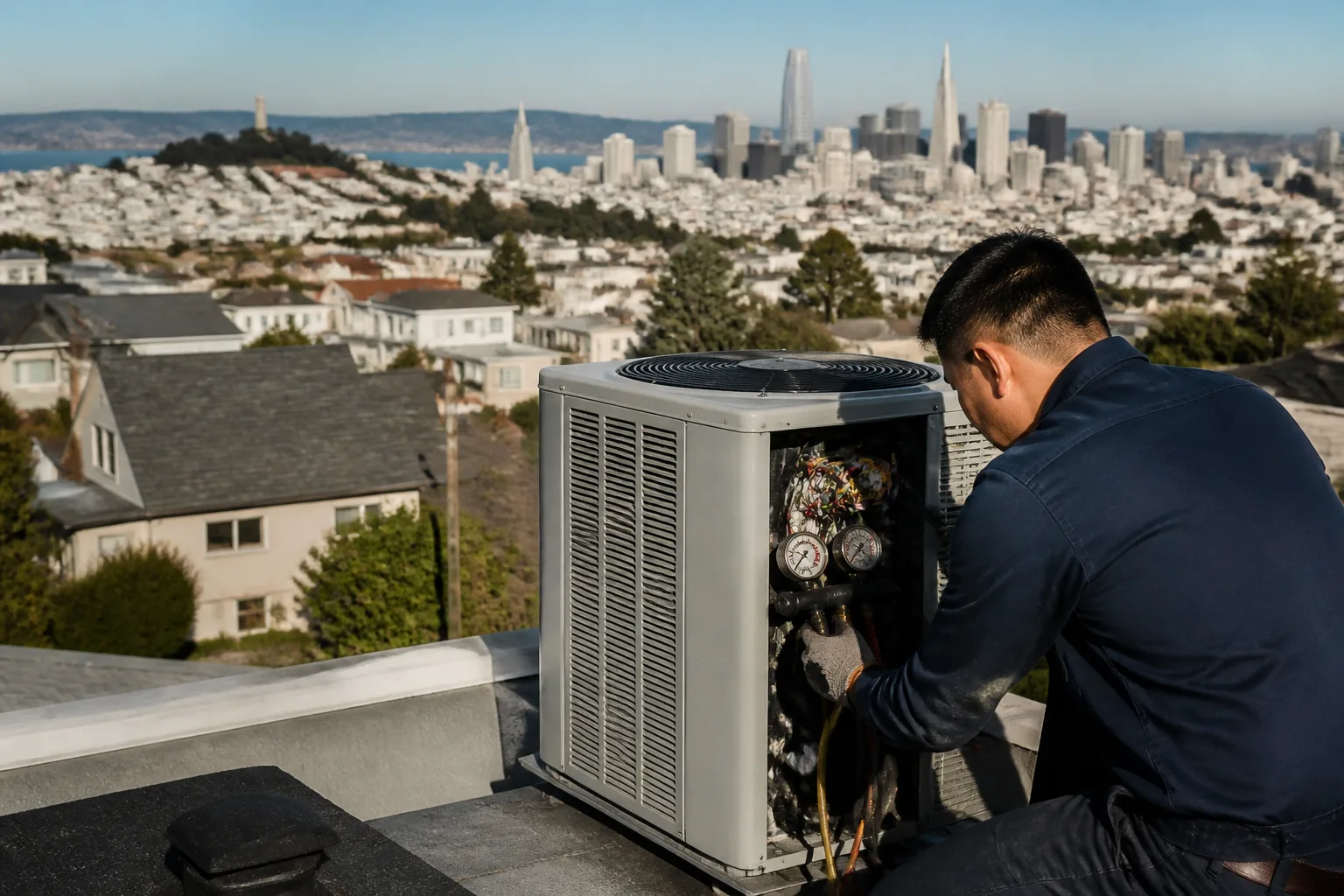
AC Repair & Installation Pricing Breakdown: What San Francisco Homeowners Pay in 2026
AC installation in San Francisco typically runs $6,800–$9,400 for a central system replacement, while repairs range from $180 for a simple tune-up to $2,800 for a major compressor fix. These prices sit 35–50% above national averages, but the gap comes from four specific, verifiable cost drivers, not contractor markup. If you’d rather skip the research and get a line-item quote for your home, call us at (855) 600-3322 — estimates are free.
We see it every week: a homeowner in Noe Valley or the Richmond gets three quotes for a new AC system and the numbers swing by $3,000 or more. Most people assume someone’s trying to rip them off. Usually, that’s not it. The quotes are pricing entirely different scopes of work, and the contractor who bundles everything into one line item isn’t necessarily the cheapest — just the hardest to compare.
Here’s what actually drives San Francisco AC pricing, what fair market rates look like in 2026, and how to read a quote like someone who’s been doing this for ten years.
Why San Francisco AC Costs Run Higher Than National Averages
Four factors explain nearly the entire price gap between San Francisco and the rest of the country. None of them are mysterious, and none are going away.
Labor rates for C-20 licensed contractors. San Francisco’s prevailing wage requirements and cost of living push HVAC technician rates well above national norms. A C-20 Warm-Air Heating, Ventilating and Air-Conditioning contractor in SF typically bills $140–$185 per hour, compared to $85–$120 in markets like Phoenix or Atlanta. This isn’t greed — it’s what it costs to employ skilled technicians who can legally pull permits and sign off on refrigerant handling.
Permit and inspection fees. San Francisco’s Department of Building Inspection requires permits for any AC installation that modifies electrical or refrigerant lines. Plan on $450–$780 for residential permits, plus the cost of scheduling inspections that can add a day or two to the project timeline. Some contractors absorb this; others break it out. Either way, you’re paying it.
Equipment markup tied to distributor concentration. The Bay Area has fewer HVAC distributors than Southern California or Texas, and freight costs from regional warehouses run higher. Most contractors mark up equipment 15–25% above their cost — that’s standard and fair. When you see 40% or more, that’s worth questioning.
Access surcharges for SF’s built environment. Narrow lots in the Sunset, multi-story Victorians in the Mission, and homes with no alley access in North Beach all require creative rigging, crane rentals, or additional labor. We’ve done installs where getting the condenser to the backyard took longer than the actual hookup. These aren’t padding — they’re real costs.
2026 San Francisco AC Pricing by Job Type
These ranges reflect what we’re seeing across the city in early 2026, from Pacific Heights to Bayview. Your specific quote depends on equipment size, brand, and access difficulty.
| Service | Typical Range | What Affects Price |
|---|---|---|
| Annual AC tune-up | $180–$260 | System age, accessibility, whether coils need deep cleaning |
| Refrigerant recharge (R-410A) | $320–$580 | Leak detection, pounds needed, line set length |
| Capacitor or contactor replacement | $240–$420 | Part quality, emergency vs. scheduled |
| Compressor replacement | $1,800–$2,800 | Single-stage vs. variable-speed, warranty status |
| Single-zone mini-split install | $3,400–$5,200 | Line set distance, electrical run, wall material |
| Central AC system replacement | $6,800–$9,400 | Tonnage, SEER2 rating, ductwork condition, brand |
| Full HVAC system (AC + furnace) | $10,500–$14,000 | Dual-fuel setup, zoning, smart thermostat integration |
We installed a Daikin mini-split last month for a client in the Outer Sunset whose 1920s bungalow had zero ductwork. The job came in at $4,100 — right in that middle range — because we could run line sets through an existing crawl space instead of opening walls. Small access wins like that save real money.
How to Read a Line-Item Quote (And Spot the Red Flags)
A proper San Francisco AC quote should break out at minimum: equipment model and SEER2 rating, labor hours or flat-rate labor, permit fees, refrigerant and materials, and any access or crane charges. If you see one number with a vague description like “complete installation,” ask for the detail. You’re not being difficult — you’re being smart.
Three legitimate ways to reduce your cost without cutting corners:
- Time your install during shoulder season. We book fewer emergency calls in April and October, which means more flexible scheduling and sometimes better equipment availability. Contractors with lighter calendars are more likely to negotiate on margin.
- Keep your existing ductwork if it’s sound. A full duct replacement can add $2,500–$4,500 to a central system install. Have your contractor pressure-test and inspect before assuming replacement is needed. We’ve saved clients thousands by sealing and balancing existing ducts instead.
- Choose a 15–16 SEER2 unit over a top-tier 20+ model. In San Francisco’s mild climate, the payback period on ultra-high-efficiency equipment often exceeds the system’s lifespan. A well-installed Bryant or American Standard 16 SEER2 unit will serve you better than a poorly installed 21 SEER2 system.
Red flags in low-ball quotes:
- No mention of permit fees — this often means the contractor plans to skip permits entirely, which voids your homeowner’s insurance if something goes wrong
- Non-ENERGY STAR equipment, which disqualifies you from utility rebates and often indicates gray-market or discontinued stock
- No contractor’s license number on the quote (verify at cslb.ca.gov)
- Payment terms demanding 50%+ upfront before materials arrive
We turned down a job in the Tenderloin last year where the homeowner showed us a $4,200 quote for a “complete central AC replacement.” The contractor had no CSLB license, specified a 13 SEER unit that can’t legally be installed in California, and excluded all permits. The real cost to do that job right would have been triple. The homeowner called us back two months later after that contractor disappeared with the deposit.
When to Repair vs. Replace Your AC in San Francisco
The standard rule — replace if repairs exceed 50% of replacement cost — applies, but San Francisco’s climate and energy costs modify the math. Our cooling degree days are a fraction of Houston’s or Miami’s, so your AC runs less and wears slower. A 12-year-old system that would be dead in Phoenix might have four useful years here.
That said, if your system uses R-22 refrigerant (phased out since 2020), replacement is usually the better call. R-22 reclamation costs have spiked, and leaks become money pits. We mark refrigerant type clearly on every diagnostic report so you can make an informed choice.
When you’re facing a major repair, ask your contractor for both options with honest lifecycle costs. At AC Repair & Installation in San Francisco, we quote repair and replacement side-by-side when both are viable. No point in selling you a new system you don’t need — our reputation lives on whether you call us back in five years, not on today’s invoice.
Related Services in San Francisco
If you’re also heating a home built before 1960, you might be running an ancient furnace alongside that aging AC. We handle both sides of the system at Heating & Furnace in San Francisco, and for homes without ductwork, Heat Pump & Mini Split in San Francisco covers the growing number of San Francisco homeowners switching to electric heat pumps for both heating and cooling.
What happens when you call
- 1
A real person answersNo phone trees — you reach a local pro.
- 2
You get an upfront price rangeHonest numbers before anyone is dispatched.
- 3
A background-checked tech heads outLicensed & insured, dispatched right away.
- 4
You approve before work beginsNothing starts until you say go.
The Bottom Line
San Francisco AC pricing isn’t inflated by contractor greed — it’s driven by measurable costs around labor, permits, equipment logistics, and physical access. The homeowners who get the best value aren’t the ones who find the lowest quote; they’re the ones who understand what they’re comparing and ask the right questions.
Key takeaways:
- Expect $6,800–$9,400 for central AC replacement in San Francisco, with mini-splits running $3,400–$5,200
- Always get line-item quotes that break out equipment, labor, permits, and access charges
- 15–25% equipment markup is fair; 40%+ deserves scrutiny
- Shoulder-season timing, keeping sound ductwork, and right-sizing your SEER2 rating are the three best ways to save without sacrificing quality
- Verify CSLB licensing and confirm permits are included
If you’re in San Francisco and want a quote you can actually read and compare, Northstar Heating & Air San Francisco offers free, line-item estimates. Daniel personally handles every assessment, and we’ll show you exactly where your money goes. Call (855) 600-3322 or book online.
Frequently Asked Questions
Central AC system replacement in San Francisco typically costs $6,800–$9,400, while single-zone mini-split installations run $3,400–$5,200. These prices reflect higher local labor rates, permit fees, and access challenges specific to San Francisco’s housing stock. For an exact quote on your home, call (855) 600-3322 — our estimates are free and itemized.
Repair makes sense when the fix costs under 50% of replacement and your system is under 12 years old. In San Francisco’s mild climate, well-maintained systems often last 15–18 years, so the standard replacement timeline stretches longer than in hotter regions. If your system uses phased-out R-22 refrigerant, replacement is usually the smarter financial call. We quote both options honestly so you can decide — call (855) 600-3322 to schedule a diagnostic.
Four traceable factors explain the gap: C-20 licensed technician rates of $140–$185/hour, SFDBI permit fees of $450–$780, limited local HVAC distributor competition raising equipment costs, and access surcharges for narrow lots and multi-story homes. These are real costs, not padding. The contractor who explains them transparently is usually the one you want.
No. Unpermitted work voids your homeowner’s insurance, creates liability exposure, and triggers penalties if discovered during a home sale inspection. Reputable contractors include permits in every quote. If a contractor suggests working without permits, that’s a disqualifying red flag. At Northstar, we pull permits on every job — it’s non-negotiable. Call (855) 600-3322 for a properly permitted installation quote.
Written by Daniel Okafor, Owner & Lead Technician at Northstar Heating & Air San Francisco, serving San Francisco since 2016.
Need HVAC Help?
Call Northstar Heating & Air San Francisco — licensed & insured, here with fast after-hours help in San Francisco.
(855) 600-3322