
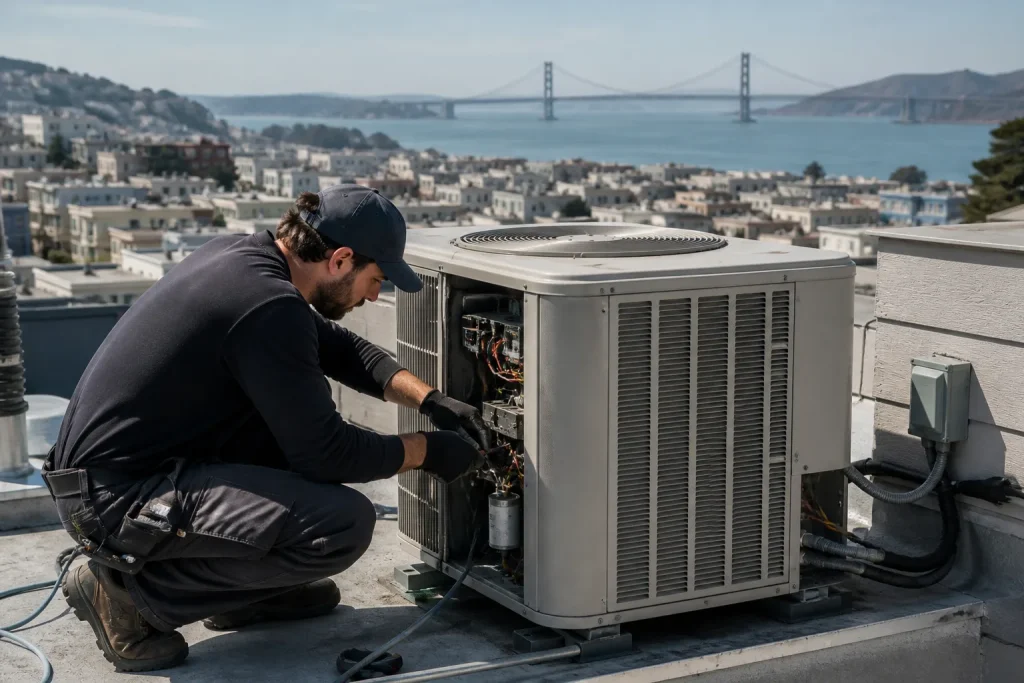
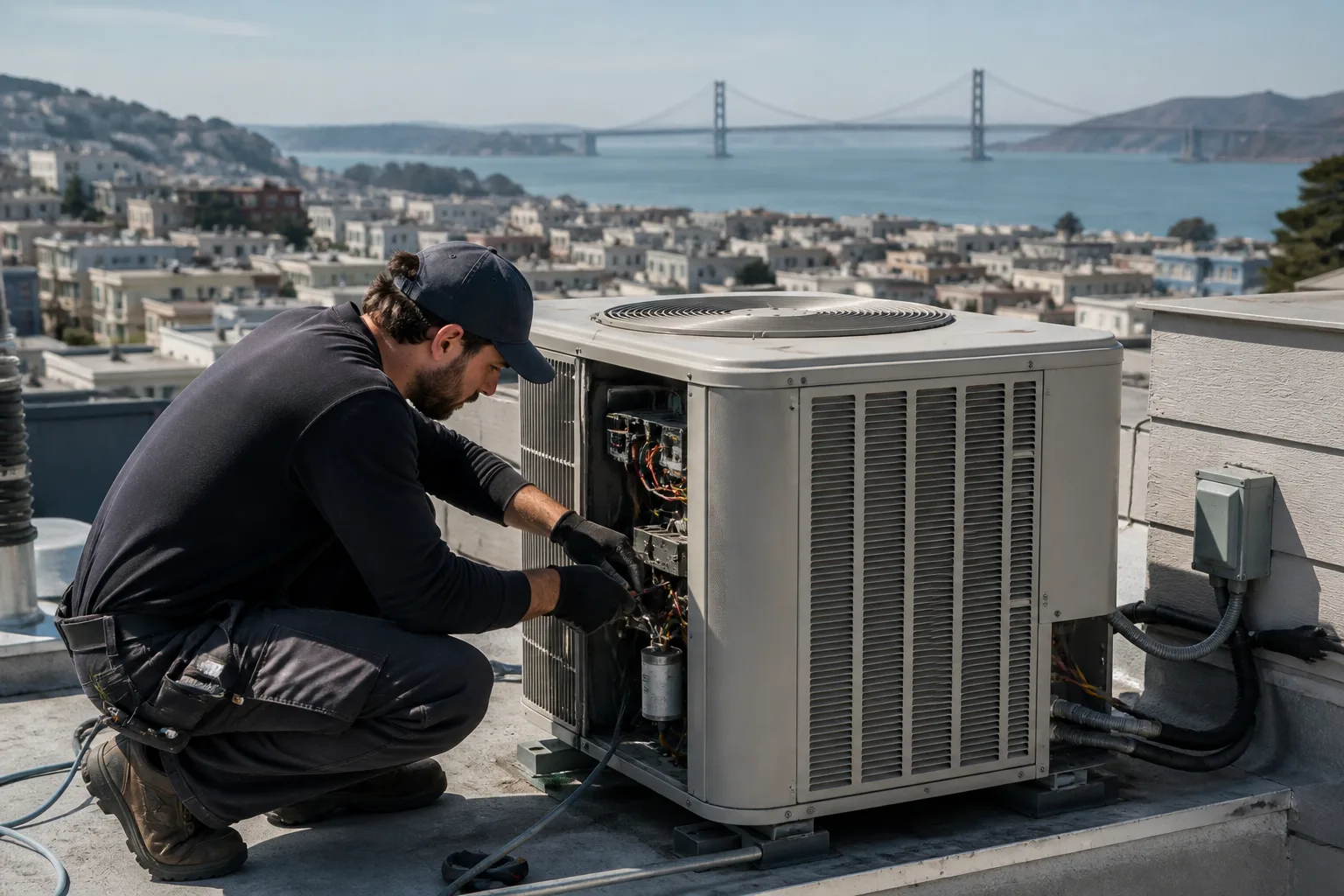
Air Quality & Ventilation: Repair or Replace? How San Francisco Homeowners Decide
Most San Francisco ventilation systems need repair rather than full replacement, but the wrong repair wastes money if your home’s envelope can’t support modern mechanical ventilation. After the 2020 wildfire smoke events, we saw a spike in ERV and HRV inquiries — but most homeowners were asking which unit to buy, not whether their 1920s ductwork and balloon-frame walls could support any mechanical ventilation at all. If you’d rather not figure this out alone, Northstar Heating & Air San Francisco offers free assessments — call (855) 600-3322.
Why San Francisco Homes Break the Standard Rules
The ventilation advice you’ll find online assumes 1990s-or-newer construction with sealed envelopes, modern duct sizing, and insulation that actually meets code. That describes almost none of the housing stock we work on in San Francisco.
Most of the city’s residential buildings went up before 1980. We’re talking uninsulated balloon-frame construction, no vapor barriers, original windows, and ductwork that was retrofitted sometime in the 1970s if you’re lucky. In the Outer Sunset last month, we looked at a 1923 stucco-over-redwood house where the “ventilation system” was a bathroom fan from 1987 and whatever air leaked through the original sash windows.
Here’s what this means for your repair-or-replace decision:
- Adding an ERV or HRV to leaky construction can actually increase energy costs without improving air quality
- Manufacturer efficiency ratings assume tight envelopes — your real-world performance will be 30-50% lower
- Moisture management in fog-belt neighborhoods works differently than dry-climate specs predict
- Duct sizing from the 1970s rarely supports modern airflow requirements
We’ve learned to start every ventilation consultation with a blower-door-informed assessment, not a catalog of unit options. Daniel personally handles these evaluations because the wrong recommendation here costs homeowners $4,000 to $8,000 with nothing to show for it.
Repair vs. Replace: The Actual Decision Tree
Not every air quality problem needs a whole-home solution. The mistake we see most often is conflating three very different scopes:
Bath/kitchen exhaust fan repair or replacement — Usually a $200-$600 fix. If your fan is noisy, slow, or dead, replace the motor or the whole unit. This is localized moisture control, not whole-home ventilation. Don’t let anyone sell you an ERV because your bathroom fan rattles.
Duct repair and sealing — $800-$2,400 typically. If your existing forced-air system has airflow problems, leaky ducts are often the culprit. In San Francisco’s older homes, we’ve found disconnected runs in crawl spaces and attic ducts that have been open to the roof cavity for years. This repairs distribution, not ventilation — but it’s often the right first step.
Whole-home mechanical ventilation (ERV/HRV) — $3,500-$8,500 installed. Only makes sense if your envelope is reasonably tight and you need controlled fresh air exchange. We see this mis-spec’d constantly.
The diagnostic questions Daniel asks before recommending anything: What’s your current air leakage rate? Where does moisture show up seasonally? Do you have forced-air ductwork already, or are we starting from scratch? What’s driving the concern — wildfire smoke, mold, condensation, or something else?
357 customers agree that getting this sequence right matters more than brand selection.
What MERV-13 Actually Does in San Francisco Conditions
After the 2018 and 2020 wildfire seasons, MERV-13 became the default recommendation for San Francisco homeowners worried about smoke infiltration. Here’s the reality we measure in the field.
A MERV-13 filter in your existing furnace or air handler catches fine particulates — PM2.5 — that slip through lesser filters. In September 2020, when AQI hit 200+ across the Bay Area, homes with MERV-13 and recirculating forced-air systems maintained indoor AQI below 50. That’s real protection.
But MERV-13 does nothing for three critical problems:
- It doesn’t bring in fresh oxygen or exhaust CO2 — it only filters recirculated air
- It doesn’t control moisture, so fog-belt mold pressure continues unchanged
- Without a blower running continuously, it only works when heating or cooling cycles on
We installed Bryant systems with MERV-13 capability in several Inner Richmond homes after 2020, and the feedback was consistent: great for smoke events, but stuffy by day three of keeping windows closed. That’s the CO2 buildup talking. For true ventilation, you need mechanical fresh air exchange — but again, only if your envelope can support it.
When to call a pro: If you’re considering MERV-13 as your complete wildfire smoke strategy, call us. We’ll test whether your system can handle the airflow restriction and whether you need paired mechanical ventilation.
The Fog-Belt Mold Problem Nobody Talks About
San Francisco’s western neighborhoods — Outer Sunset, Parkside, parts of the Richmond — sit in persistent marine layer for months each year. Exterior moisture loads run 2-3x higher than manufacturer design specs for most of the country. This changes everything about HRV core longevity.
HRV cores exchange heat between incoming and outgoing air streams. In dry climates, these last 10-15 years with basic maintenance. In our fog belt, we’ve seen cores degrade in 5-7 years because the condensation cycle runs almost continuously through summer. The aluminum or polymer matrix develops mineral deposits, biological film, and eventually airflow-blocking corrosion.
We pulled a failed HRV core out of a garage over in the Outer Sunset last year where the homeowner had been told to expect 12-year service life. At year six, airflow was down 60% and the unit was actually adding moisture to the home. The replacement core cost $800, but the real problem was the original spec — an HRV in that microclimate needed more frequent maintenance intervals and possibly an ERV instead, which transfers moisture as well as heat.
This is why 9 major brands, one company matters for San Francisco homeowners. We’ve worked on Carrier, Trane, American Standard, and other systems where the local rep had never heard of fog-belt mold acceleration. Daniel’s seen enough of these failures to know which manufacturer specs to trust and which to adjust.
Related services in San Francisco: If your ventilation concerns tie into broader HVAC needs, see our AC Repair & Installation in San Francisco and Heating & Furnace in San Francisco pages.
Getting an Honest Assessment Without the Sales Pitch
The HVAC industry makes more money replacing systems than repairing them. That’s not cynical — it’s structural. Commission-based techs are incentivized to find problems that justify new equipment. We’ve all gotten the call where another company condemned a perfectly serviceable unit.
Here’s how we handle it differently. Daniel personally runs every ventilation assessment at Northstar. No rotating crew, no commission structure, no dispatcher filtering information. When we recommend repair over replacement, we mean it — our 4.9-star rating across 357 reviews reflects a decade of doing this right, not a decade of maximizing invoice totals.
A legitimate ventilation assessment in San Francisco should include:
- Visual duct inspection with photo documentation of any damage or leakage
- Blower door or pressure pan testing to quantify envelope leakage
- Moisture mapping — where and when do you see condensation, mold, or mustiness?
- Existing equipment capacity and condition review
- Clear explanation of whether your problem is distribution, filtration, or ventilation
Anyone who skips to unit recommendations without this sequence is selling, not diagnosing. Whether it’s an emergency call or a full system install, the diagnostic comes first.
The Bottom Line
Repair your San Francisco ventilation system if the problem is localized — a dead fan, leaky duct run, or clogged filter. Replace with whole-home mechanical ventilation only if your envelope is tight enough to support it and your specific concern requires fresh air exchange, not just filtration or distribution. The 2020 wildfire smoke panic pushed a lot of homeowners toward ERVs they didn’t need; the fog-belt mold reality means some HRVs were spec’d wrong from the start.
Key takeaways:
- San Francisco’s pre-1980 housing stock changes every baseline assumption about ventilation performance
- MERV-13 helps with wildfire smoke but does not ventilate — know the difference
- Fog-belt moisture accelerates HRV degradation faster than national timelines predict
- Repair vs. replace should follow diagnostic sequence, not sales pressure
- Envelope tightness determines whether any mechanical ventilation investment makes sense
If you’re in San Francisco and need help sorting repair from replacement, Northstar Heating & Air San Francisco offers free estimates — call (855) 600-3322. Daniel handles the assessment personally, and you’ll get a straight answer about what your home actually needs.
Frequently Asked Questions
Most ventilation repairs in San Francisco run $200-$2,400 depending on scope. A bath fan motor replacement might hit $350, while full duct sealing with testing runs toward the higher end. Whole-home ERV or HRV installation starts around $3,500 and can reach $8,500 if we’re running new ductwork through finished spaces. Call (855) 600-3322 for an exact quote — estimates are free.
Repair is almost always cheaper in the short term, but replacement saves money if your current system is mis-spec’d for San Francisco conditions. We’ve seen homeowners spend $1,800 repairing a duct system that was fundamentally undersized, then need full replacement two years later. The honest answer depends on your envelope tightness, moisture patterns, and whether your current setup can ever achieve your air quality goals. A proper diagnostic prevents the double-spend.
A MERV-13 filter provides meaningful protection against wildfire smoke particles, but only when your HVAC blower is running and only for recirculated air. It does not bring in fresh oxygen or exhaust indoor pollutants. During extended smoke events, you’ll need paired strategies: MERV-13 filtration plus controlled mechanical ventilation or deliberate window management. We’ve installed American Standard systems with MERV-13 capability that performed well in 2020’s smoke, but the homeowners who stayed most comfortable also had ERVs for fresh air exchange.
Your home likely needs mechanical ventilation if it’s been air-sealed or built tight and you experience stuffiness, condensation, or persistent odors with windows closed. In San Francisco’s older housing stock, most homes leak enough air naturally that ERV/HRV isn’t automatically justified. We test envelope leakage first — if you’re above 10 ACH50, sealing comes before ventilation investment. The fog-belt neighborhoods often favor ERV over HRV because they transfer moisture, reducing summer condensation load. Call (855) 600-3322 and Daniel will walk you through the specific diagnostic for your home.
Written by Daniel Okafor, Owner & Lead Technician at Northstar Heating & Air San Francisco, serving San Francisco since 2016.
Need HVAC Help?
Call Northstar Heating & Air San Francisco — licensed & insured, here with fast after-hours help in San Francisco.
(855) 600-3322