
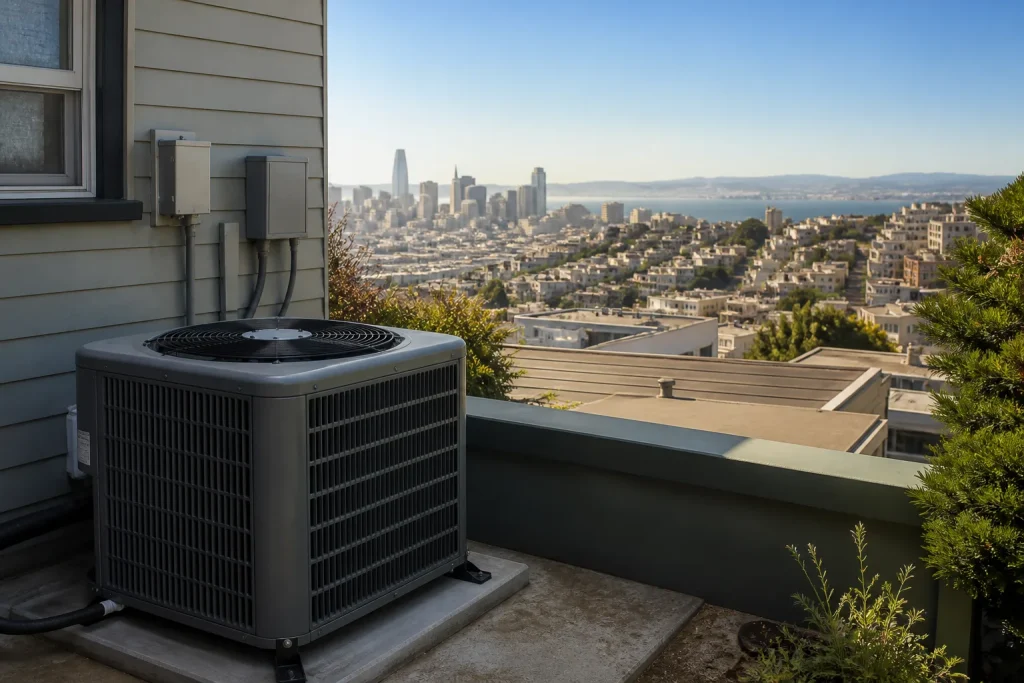
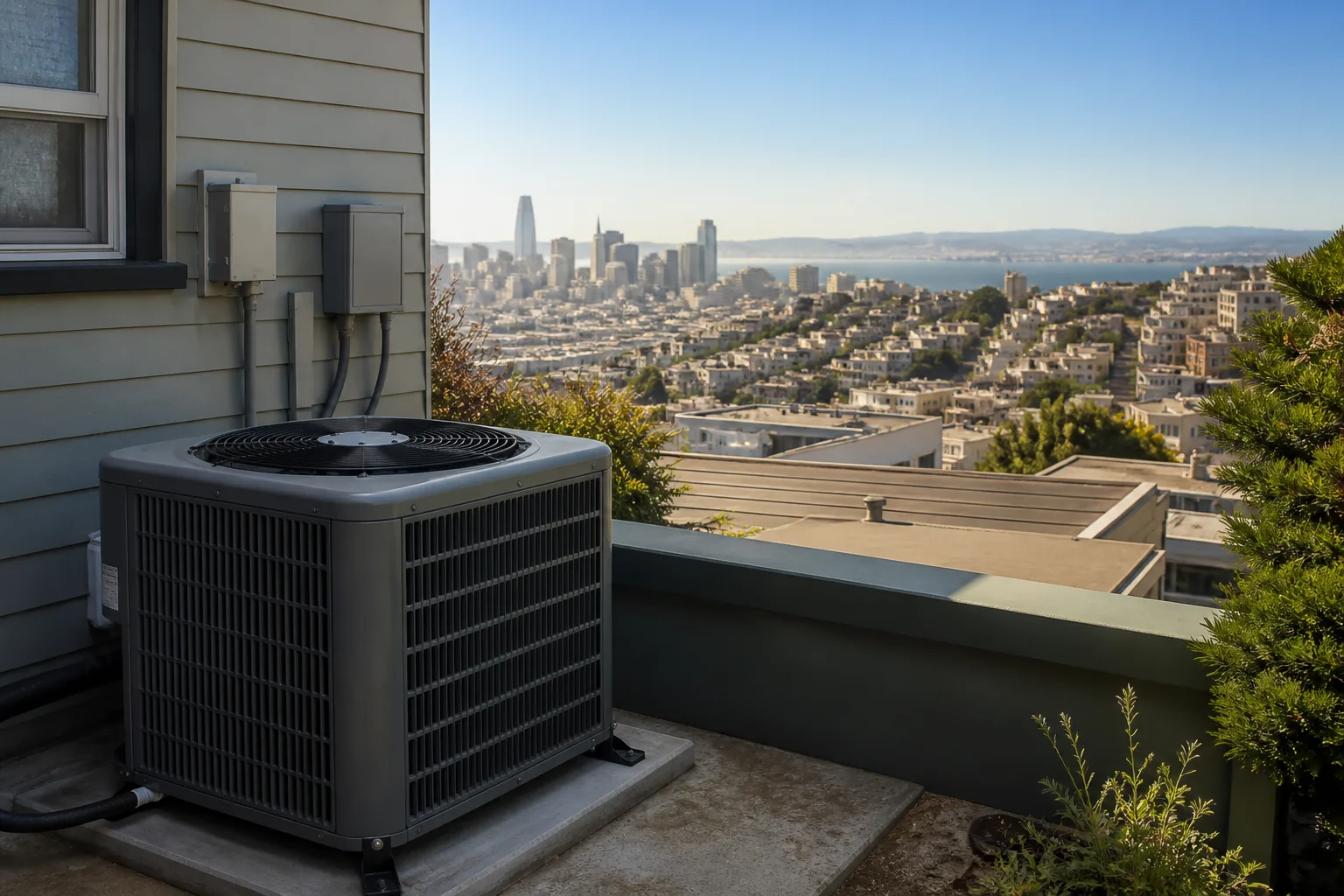
Goodman AC Repair & Installation in San Francisco: A Homeowner’s Guide
Goodman AC installation in San Francisco typically costs $3,800–$6,500 for a standard split system, while repairs run $180–$450 for common issues like capacitor or contactor failures. In our low-use coastal climate, a properly installed Goodman unit often delivers 12–15 years of reliable cooling without the premium price tag. If you’d rather not sort through brand claims yourself, call us at (855) 600-3322 for a free, no-pressure estimate.
Here’s the thing about San Francisco and air conditioning: your unit runs roughly 200 hours a year. Compare that to Phoenix at 2,000+ hours. In a city where the Outer Sunset hits 62°F in July and the Mission might touch 85°F for a week straight, the performance gap between a Goodman and a Carrier or Trane narrows dramatically. What doesn’t narrow is the $3,000–$5,000 upfront difference. For a 1,200 square foot Edwardian in the Haight with original windows and no insulation, that math deserves real attention.
We’ve been installing and repairing Goodman equipment across San Francisco for a decade. Daniel Okafor, our owner and lead technician, has worked on hundreds of these units from the Marina to Bayview. Here’s what actually matters for your decision.
Who Actually Makes Goodman Now (And Why Parts Availability Isn’t the Problem People Think)
Goodman Manufacturing became a Daikin subsidiary in 2012. Daikin is the world’s largest HVAC manufacturer, and that acquisition fundamentally changed Goodman’s supply chain. Before 2012, parts availability was spotty and warranty claims moved slowly. Today, Goodman shares component architecture with Daikin and Amana systems, and warranty parts ship through the same distribution network that supports commercial Daikin VRV installations.
In San Francisco, this matters because we see a lot of inherited Goodman equipment. Homeowners in Noe Valley or the Richmond buy a place with a 2015 Goodman condenser in the side yard, assume it’s a “cheap” unit they’ll need to replace, and don’t realize the warranty backstop is Daikin’s global infrastructure. The 10-year parts warranty is real, but only if the original owner registered it within 60 days of installation. Most didn’t.
We carry Goodman, Daikin, and Bryant capacitors, contactors, and fan motors on our truck because the cross-compatibility is that strong. When Daniel shows up to a repair call in the Sunset District, he’s not waiting two days for a proprietary part. That’s a practical difference that doesn’t show up in brand comparison charts online.
Where Goodman Makes Sense in San Francisco (And Where It Doesn’t)
Goodman’s cost advantage holds strongest in specific San Francisco conditions. Here’s where the value proposition is genuine, and where it starts to erode:
- Low-use single-zone cooling: A small home in the Sunset or Ingleside that runs AC 10–15 days a year won’t stress a Goodman’s compressor the way continuous Phoenix operation would. The simplified single-stage design is actually more repairable and less failure-prone under light load.
- Replace-only scenarios: When your coil and line set are already sized and your electrical is adequate, Goodman keeps the total project cost manageable. We’ve done replacements in the Excelsior for under $4,500 that would hit $7,500 with a premium brand.
- Properties you don’t plan to keep long-term: If you’re renovating a Bernal Heights rental and need functional cooling for 5–7 years, Goodman’s value proposition is straightforward.
Where Goodman gets more questionable: high-humidity microclimates near the coast. The Outer Richmond and parts of Daly City adjacent to San Francisco can see condensation issues that stress heat exchangers. Goodman uses aluminum coils in many units, which corrode faster than copper in salt-air environments if not maintained. We inspect for this specifically on coastal calls. Also, if you’re doing a full system with ductwork redesign, the efficiency differences between Goodman and a modulating Carrier or American Standard become more relevant to operating cost.
The 60-Day Warranty Trap Almost Every SF Homeowner Misses
This is the single most expensive oversight we encounter. Goodman offers a 10-year parts warranty and a lifetime compressor warranty on qualifying units, but registration is mandatory within 60 days of installation. The original purchaser must complete it online with the serial number and installation date.
In San Francisco’s real estate market, that original purchaser is rarely the current occupant. We’ve opened units in the Mission where the 2018 install date is stamped on the data plate, but the third owner since then has no warranty coverage because nobody transferred or re-registered. The unit is mechanically fine, but a $400 compressor failure becomes fully out-of-pocket.
If you’re buying a home with an existing Goodman system, check the installation date and call Goodman directly with the serial number. If it’s within that 60-day window, register immediately. If it’s past, budget for repairs as if there’s no warranty, because functionally there isn’t. Daniel always pulls the data plate on Goodman service calls in San Francisco specifically to check this, it’s saved several customers from surprise bills.
Common Goodman Repairs We See in San Francisco (And What Causes Them)
Goodman units fail in patterns that reflect how San Francisco uses them, not necessarily how they’re built. Here are the three issues Daniel diagnoses most often:
Capacitor failure from seasonal start-up surge. Your capacitor stores the electrical kick the compressor needs to start. In climates where the AC runs daily, capacitors warm up and stay conditioned. In San Francisco, where a unit might sit idle from October through May, that first hot week in June demands a hard start from a cold component. We replace more Goodman capacitors in late May and early June than any other month. It’s not a quality defect, it’s a use-pattern issue.
Contactor pitting from low-voltage fluctuation. San Francisco’s older grid infrastructure, particularly in pre-1940s neighborhoods like Pacific Heights and the Haight, delivers voltage that fluctuates more than modern suburbs. The contactor, which switches high voltage to the compressor, develops carbon pits on its contacts. Eventually it sticks open or closed. We check contactor condition on every maintenance visit, it’s a $180 repair that prevents a $1,200 compressor replacement.
Refrigerant leaks at flare connections. Goodman’s line sets connect with flared fittings rather than brazed joints on some models. If the original installer didn’t torque the flare nut correctly, the thermal expansion and contraction of San Francisco’s temperature swings, 45°F mornings to 75°F afternoons in spring, gradually loosens the seal. We find these with electronic leak detectors and re-flare with a calibrated torque wrench. The fix is precise, not guesswork.
How to Tell If a Contractor’s Brand Recommendation Is About Your Needs or Their Margin
We’ve been on calls in San Francisco where a homeowner was quoted $8,500 for a “minimum viable” system and told Goodman wasn’t “appropriate for this climate.” That’s nonsense. San Francisco’s climate is among the gentlest in the country for HVAC equipment. What that contractor meant was: Goodman doesn’t pay their spiff, or their labor warranty model depends on fewer callbacks than they’re willing to absorb.
Here are the questions that separate genuine engineering concerns from sales theater:
- Ask for specific load calculations. A contractor who won’t run a Manual J calculation and instead sizes by “rule of thumb” isn’t evaluating your home, they’re selling inventory. We’ve replaced 3-ton units in the Sunset with correctly sized 2-ton systems that perform better and cost less.
- Ask why Goodman won’t work, specifically. “It’s builder-grade” isn’t an answer. “The aluminum coil in your salt-air microclimate needs annual treatment” is a real concern. “You need a two-stage compressor for your 900 square foot flat” is probably not.
- Compare warranty terms apples-to-apples. Some premium brands offer 12-year parts coverage, but read the registration requirements and transferability. Goodman’s 10-year parts warranty, if registered, often outlasts the average San Francisco homeowner’s tenure in a given property.
- Check who’s doing the actual install. A Goodman installed with proper evacuation, correct charge, and sealed ductwork will outperform a poorly installed Trane every time. At Northstar Heating & Air San Francisco, Daniel personally handles every installation. One technician, start to finish, with his name on the permit and his reputation on the line.
We’re certified on nine major brands: Carrier, Trane, Lennox, Goodman, Rheem, York, Daikin, Bryant, and American Standard. When we recommend Goodman, it’s because the numbers work for your specific situation. When we recommend against it, we’ll tell you exactly why, with measurements, not brand prejudice.
When to Call a Pro for Goodman AC Issues
Some maintenance is homeowner-friendly: keeping the condenser clear of leaves, changing the filter monthly during use, checking that the disconnect switch is on after a power outage. But Goodman units, like all split systems, contain high-voltage electrical components and pressurized refrigerant. If your unit hums but won’t start, cycles rapidly, or blows warm air, the diagnostic involves electrical testing and refrigerant measurement that requires EPA certification and proper tools.
We’ve responded to emergency calls in San Francisco where a homeowner attempted a capacitor replacement after watching a video and discharged 240 volts through a screwdriver. The capacitor wasn’t even the problem. Don’t be that person. The diagnostic fee is $89–$129. The ER visit is substantially more.
For related services in San Francisco, see our full AC Repair & Installation in San Francisco page, or explore Heating & Furnace in San Francisco and Heat Pump & Mini Split in San Francisco if you’re considering alternatives to traditional central air.
The Bottom Line
Goodman occupies an honest place in San Francisco’s HVAC market: not the best-engineered system money can buy, but frequently the most rational purchase for low-use coastal cooling. The Daikin ownership since 2012 resolved the parts and warranty infrastructure issues that plagued earlier generations. The 60-day registration window remains a genuine trap for second and third owners. And the repair patterns we see, capacitor failures from seasonal starts, contactor pitting from grid fluctuation, flare leaks from temperature cycling, are all manageable with competent maintenance.
The brand choice matters less than the installation quality and the accountability of the person standing behind it. A decade of doing this right in San Francisco has taught us that much.
Key takeaways:
- San Francisco’s 200-hour annual AC load reduces the performance gap between Goodman and premium brands
- Daikin’s 2012 acquisition of Goodman solved parts availability; warranty registration in 60 days is critical
- Capacitor and contactor failures reflect San Francisco’s seasonal use patterns, not brand quality
- Installation quality and technician accountability matter more than brand badge
- Coastal salt-air properties need specific coil inspection for corrosion risk
If you’re weighing Goodman against other options for your San Francisco home, or you’ve got an existing unit that needs honest diagnosis, call Northstar Heating & Air at (855) 600-3322. Daniel Okafor handles every estimate personally, and we’ll tell you straight whether Goodman makes sense for your situation or whether another of the nine brands we service fits better. Estimates are free, and we don’t sell what you don’t need.
Frequently Asked Questions
Goodman AC installation in San Francisco typically runs $3,800–$6,500 for a standard split system replacement, and $5,500–$8,500 if new ductwork or electrical upgrades are needed. The Outer Sunset and Richmond districts often fall on the lower end due to smaller homes and simpler access; hillside properties in Noe Valley or Twin Peaks can push costs higher for crane or rigging requirements. We provide itemized quotes with no hidden charges. Call (855) 600-3322 for a free estimate at your specific address.
Yes, generally. Goodman replacement parts cost 15–30% less than equivalent Carrier or Trane components, and the simpler single-stage design means fewer proprietary control boards to fail. A typical Goodman capacitor or contactor repair in San Francisco runs $180–$280, where premium-brand equivalent repairs often hit $250–$400. The labor is similar; the parts differential is where the savings live. For an exact quote on your specific repair, call (855) 600-3322, estimates are free.
We offer same-day emergency HVAC service for San Francisco residents when your system is completely down during a heat event. Standard installations typically schedule within 3–5 business days, depending on permit timing and your availability. Daniel Okafor personally handles every installation, so we don’t overbook. For urgent cooling needs, call (855) 600-3322 and we’ll give you a realistic timeline based on current demand.
If your Goodman is under 10 years old and the repair is under $600, repair is usually the rational choice. Between 10–15 years, weigh the repair cost against replacement: if the repair exceeds 30% of replacement cost and other major components show wear, replacement often wins. Over 15 years, Goodman parts availability remains strong due to Daikin’s ownership, but efficiency gains from a new 14+ SEER unit start paying back in the small but real operating savings. Daniel evaluates this honestly on every call, we’re not incentivized to push replacement when repair makes sense. Call (855) 600-3322 for a no-pressure assessment.
Written by Daniel Okafor, Owner & Lead Technician at Northstar Heating & Air San Francisco, serving San Francisco since 2016.
Need HVAC Help?
Call Northstar Heating & Air San Francisco — licensed & insured, here with fast after-hours help in San Francisco.
(855) 600-3322