
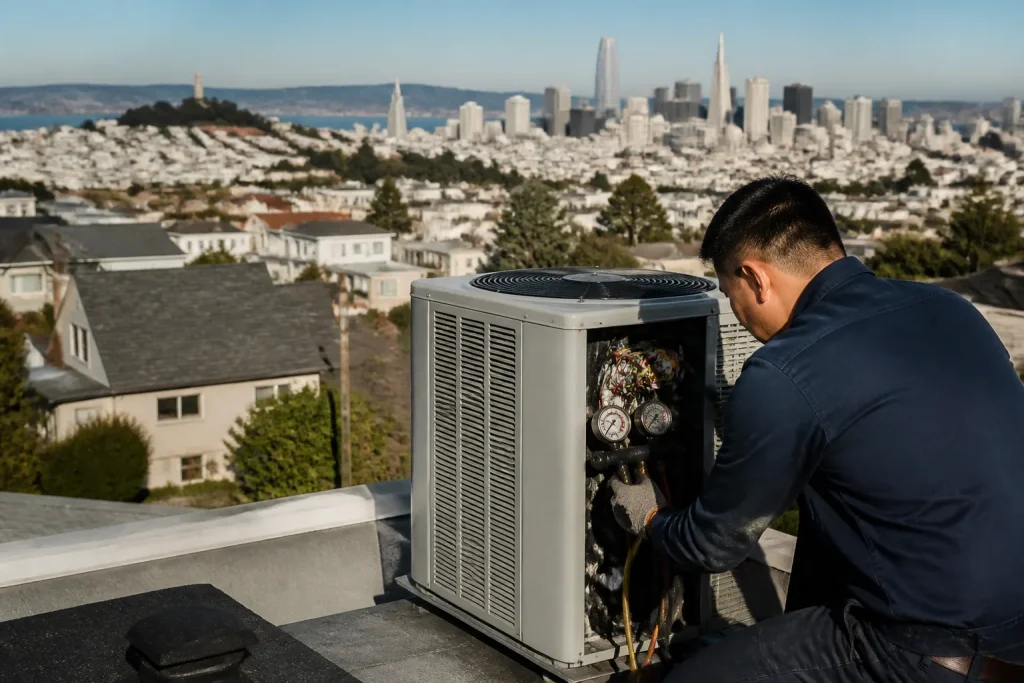
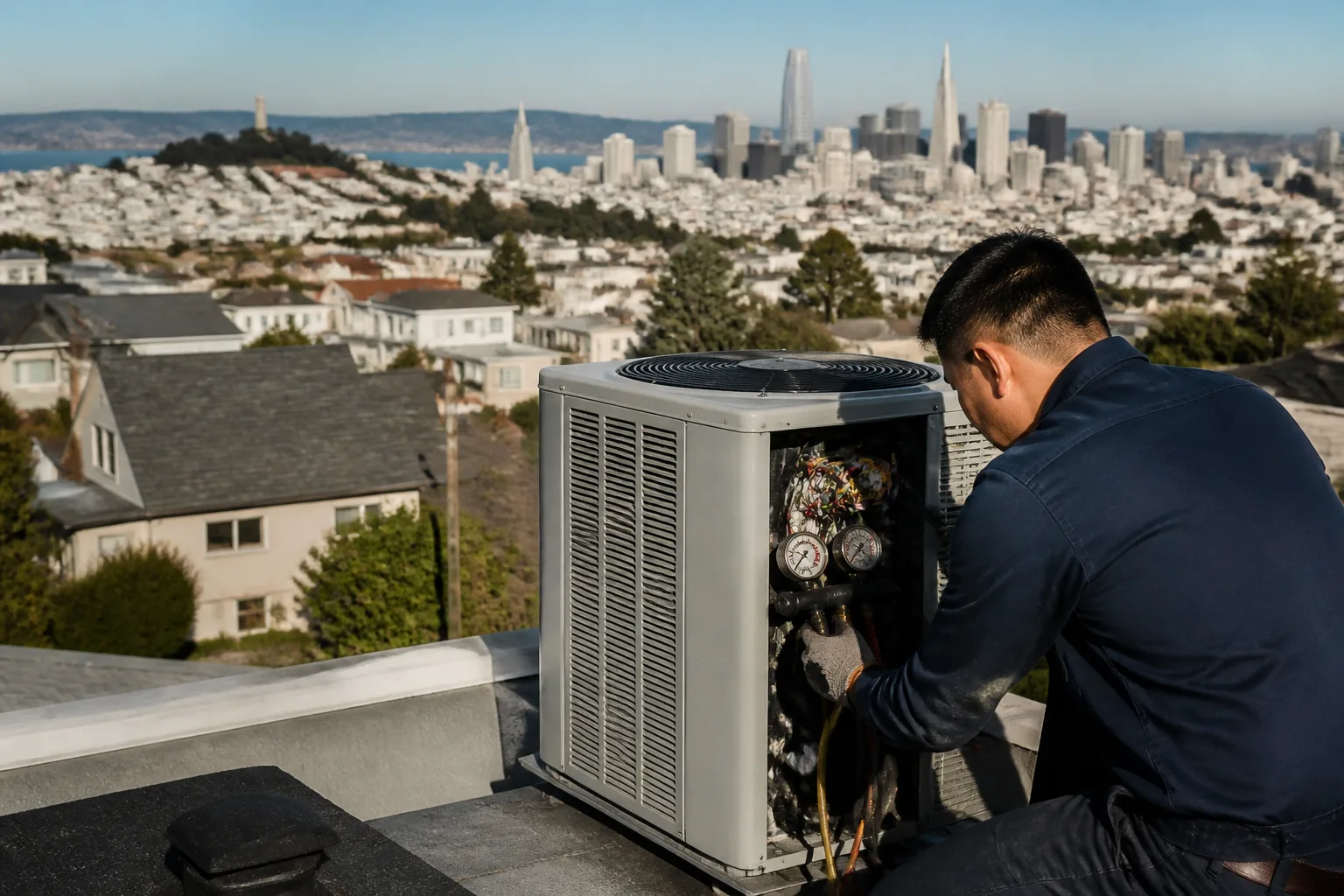
Rheem AC Repair & Installation in San Francisco: A Homeowner’s Guide
Rheem AC repair in San Francisco typically costs $180–$650 depending on the component, with blower motor replacements running $400–$850 and full system installs ranging $5,500–$9,500 for the RA and RH series most common in the city. If your Rheem unit was built between 2012 and 2018, there’s a known ECM blower motor failure pattern that Rheem addressed in a 2019 technical bulletin, and most San Francisco homeowners with repeat blower issues don’t realize the part itself, not their installation, is the root cause. If you’d rather not diagnose this yourself, call us at (855) 600-3322 for a free estimate.
Which Rheem Models Are Most Common in San Francisco Homes
Walk through any Outer Sunset, Richmond, or Bernal Heights neighborhood and you’ll find the same handful of Rheem units humming in backyards and side yards. After ten years of opening panels across the city, we’ve got a clear picture of what’s actually out there.
The RA14 and RA16 single-stage units dominate the 2010–2020 install base. These are workhorse systems, 14 and 16 SEER respectively, built for moderate climates. In San Francisco’s low-runtime coastal environment, they often last 15–18 years if maintained, though the salt air in neighborhoods like the Marina and Sunset can accelerate coil corrosion by 20–30% compared to inland Bay Area cities.
The RH1V and RH2V variable-speed air handlers paired with Rheem heat pumps gained traction after 2015, especially in Noe Valley and Pacific Heights remodels where owners wanted higher efficiency. These are the units most affected by the ECM motor issue we’ll cover below.
Older RAPL and RACA series from the early 2000s still run in pre-war buildings in the Mission and Hayes Valley. Parts are getting scarce, and we’ve had to source blower wheels from aftermarket suppliers for two Richmond District jobs this past year.
Here’s what we see most often:
- RA14/RA16: Most common overall, 2010–2020 installs, single-stage, reliable except for contactor and capacitor wear
- RH1V/RH2V: Variable-speed air handlers, 2015+, higher efficiency but ECM motor vulnerability
- Classic Plus Series (RASL, RAPM): Heat pump combinations, popular in Daly City-adjacent SF neighborhoods for dual-fuel setups
- Legacy RAPL/RACA: Pre-2010, still running in older housing stock, diminishing parts availability
The coastal climate matters more than most homeowners realize. Rheem tests its equipment at 95°F outdoor design temperatures with 80°F indoor returns. San Francisco rarely hits 80°F ambient, and many homes in the Sunset and Richmond never see indoor temperatures above 75°F even in September heat waves. That means your Rheem runs fewer hours per year than the national average, which extends compressor life but can mask developing problems until they fail catastrophically.
The 2012–2018 ECM Blower Motor Problem Every SF Owner Should Know
In 2019, Rheem issued a technical bulletin acknowledging elevated failure rates in ECM (electronically commutated motor) blower modules installed between 2012 and 2018. The issue wasn’t a recall, it was a design tolerance problem in the motor control board that caused premature failure, especially in systems with frequent start-stop cycles.
San Francisco’s climate creates exactly those conditions. Your Rheem might run for 20 minutes, shut off, then restart 40 minutes later as fog rolls in and the thermostat drifts. That cycling pattern stresses the ECM control board more than sustained operation would.
Symptoms are specific: the blower won’t start, starts and stops erratically, or runs at fixed speed instead of modulating. Homeowners often get quoted for a full system replacement when the fix is a $400–$650 motor module swap. We’ve saved three Noe Valley customers and one Bernal Heights family from unnecessary full replacements in the past eight months by diagnosing this correctly.
Which models are affected? Primarily:
- RH1V and RH2V air handlers with ECM motors (2012–2018 production)
- select RA17 two-stage systems with variable-speed blowers
- Some Rheem heat pump air handlers from the same era
The motor module itself is replaceable. Aftermarket options from Genteq and Zhongshan Broad-Ocean run $180–$320 for the part, plus 2–3 hours labor. OEM Rheem modules cost $350–$550. In our experience, the aftermarket units perform identically for this specific application, and we’ve installed dozens across San Francisco without callback issues.
Here’s the catch: if your system is out of warranty and the compressor is also showing age, a motor replacement might only buy you 3–5 years. At that point, replacement becomes the smarter math. We pulled one unit in the Outer Richmond last month where the homeowner had already replaced the ECM motor in 2021, and now the compressor was failing at 11 years total. We recommended full replacement with a new AC installation rather than sinking another $600 into a dying system.
Rheem Warranty Rules SF Homeowners Actually Need to Follow
Rheem’s warranty coverage is solid, but it’s conditional in ways that trip up San Francisco homeowners. The standard parts warranty runs 10 years on compressors and 5 years on other components for registered residential equipment. Labor coverage requires separate registration and often an extended warranty purchase through the installing contractor.
The critical requirement most people miss: the original installation must be performed by a licensed HVAC contractor and registered with Rheem within 60 days. We’ve encountered unregistered systems in the Mission and Bayview where the original installer was an unlicensed handyman or the homeowner bought equipment online and had a friend install it. In those cases, Rheem defaults to a 5-year parts warranty only, and sometimes denies coverage entirely.
For warranty service, Rheem requires work by a “certified Rheem dealer” or licensed contractor who can document refrigerant handling and electrical compliance. This isn’t brand snobbery, it’s liability protection. We’ve handled warranty claims for Sunset and Parkside customers where the previous technician had overcharged the system, causing compressor failure, and Rheem rightfully denied coverage due to improper service history.
Key warranty actions for San Francisco Rheem owners:
- Verify your install date and registration status at Rheem.com/warranty-lookup
- Keep all service invoices, refrigerant logs, and filter change records
- Use only licensed contractors for any repair that touches refrigerant lines or electrical connections
- Document any coastal corrosion issues with photos, premature coil failure can sometimes be argued as defect rather than environment
Daniel personally handles warranty paperwork for Northstar customers, we don’t leave you to fight with Rheem’s claims department alone. That direct accountability is why 357 customers have left us a 4.9-star average, and it’s the difference between a covered $1,200 compressor replacement and a denied claim.
Repair vs. Replace: SF Cost Reality for Rheem Systems
The repair-or-replace decision for Rheem AC in San Francisco has different math than Phoenix or Houston. Lower runtime means less annual wear, but higher labor costs and permit complexity affect replacement economics.
Here’s what we’re quoting in 2024 for typical San Francisco Rheem scenarios:
| Service | Typical Range | When It Makes Sense |
|---|---|---|
| Capacitor / contactor replacement | $180–$340 | Any age, simple fix |
| ECM blower motor module | $400–$850 | Under 10 years, compressor healthy |
| Condenser fan motor | $350–$620 | Under 12 years |
| Compressor replacement | $1,800–$2,800 | Under 8 years, rest of system solid |
| RA14/RA16 full replacement | $5,500–$7,200 | 12+ years, major failure, or repeated issues |
| RH2V variable-speed replacement | $7,200–$9,500 | 10+ years, efficiency upgrade desired |
San Francisco-specific cost factors: permit fees run $250–$450 depending on whether your job needs electrical upgrade or structural modification for rooftop units. Many Victorian and Edwardian homes in the Haight, Castro, and NOPA require creative mounting solutions that add $300–$800 in labor. And if you’re in a rent-controlled building or HOA with strict exterior appearance rules, expect longer lead times for aesthetic-matching equipment.
Our rule of thumb: if cumulative repair costs exceed 40% of replacement cost and your system is past 12 years, replacement usually wins. For Rheem units under 10 years with single-component failure, repair is almost always the right call. We’ve talked more than one Excelsior homeowner out of premature replacement by showing them the actual compressor amp draw and coil condition, not just selling them a new unit.
How Rheem Performs in San Francisco’s Coastal Climate
Rheem designs its RA and RH series for AHRI standard conditions: 95°F outdoor, 80°F indoor, 50% relative humidity. San Francisco averages 67°F in July and rarely cracks 85°F. Your Rheem runs below its design point almost constantly.
This has real implications. Lower head pressures extend compressor life, we’ve seen RA14s in the Sunset hit 18 years with basic maintenance. But low runtime also means less oil circulation through the compressor, which can cause bearing wear in systems that sit idle for weeks during foggy stretches. We recommend running your Rheem in fan-only mode for 30 minutes weekly during off-seasons to keep bearings lubricated.
The bigger issue is humidity control. Rheem’s single-stage units cycle on and off based on temperature alone. In July and August, when marine layer moisture is highest, your home might feel clammy at 72°F because the system hasn’t run long enough to dehumidify. The RH2V variable-speed line handles this better by running longer, lower cycles, but as noted above, those units carry the ECM motor risk.
For neighborhoods with genuine cooling load, Potrero Hill, Mission Bay new construction, top-floor units in the Mission, we size Rheem equipment differently than the Manual J calculation might suggest. A slightly undersized unit that runs longer actually delivers better comfort and humidity control than an oversized one that short-cycles. We’ve had to correct three oversized Rheem installs in SOMA condos where the original contractor used rule-of-thumb sizing and created humidity problems the equipment couldn’t solve.
Salt air corrosion is localized. Homes within three blocks of the Pacific in the Sunset, Richmond, or Sea Cliff see faster coil degradation. We treat aluminum fins with protective coating on new installs in those areas, and we inspect coastal units annually rather than biennially. It’s not Rheem-specific, Goodman and York coils show identical patterns, but Rheem’s microchannel condenser design is slightly more vulnerable to salt bridging between fins.
When to Call a Pro for Your Rheem AC
Some Rheem issues are genuinely DIY-friendly: filter changes, thermostat battery replacement, clearing debris from the outdoor condenser. But refrigerant work, electrical diagnostics, and anything involving the ECM motor module requires EPA certification and proper tools.
Call a licensed technician if you see: ice on the refrigerant lines, water pooling under the indoor unit, burning electrical smell, repeated breaker trips, or the blower symptoms we described above. In San Francisco, unlicensed refrigerant work is a $1,000+ fine and voids your warranty.
Related services in San Francisco: if your Rheem is part of a dual-fuel setup or you’re considering a heat pump conversion, see our Heat Pump & Mini Split in San Francisco page. For winter heating concerns, our Heating & Furnace in San Francisco coverage explains how Rheem gas furnaces pair with these AC systems.
The Bottom Line
Rheem makes reliable equipment, but the 2012–2018 ECM motor issue is real, and San Francisco’s start-stop coastal runtime pattern makes it worse. If you own a Rheem from that era, know your model number, check your warranty registration, and don’t let a contractor sell you a full replacement for a $500 motor module. At the same time, don’t throw good money after bad on a 14-year-old system with multiple failing components.
Key takeaways for San Francisco Rheem owners:
- RA14/RA16 units are the city’s workhorses, typically lasting 15–18 years with maintenance
- RH1V/RH2V variable-speed systems from 2012–2018 have a known ECM blower motor failure pattern
- Warranty requires licensed installation and timely registration, unlicensed work voids coverage
- Repair makes sense under 10 years for single-component failure; replacement usually wins past 12 years with cumulative issues
- Coastal corrosion and low-runtime operation create San Francisco-specific maintenance needs
If you’re in San Francisco and want an honest assessment of your Rheem, Northstar Heating & Air San Francisco offers free estimates. Daniel personally handles every diagnostic call, and we’ll tell you straight whether repair or replacement is the right call. Call (855) 600-3322 or book online.
Frequently Asked Questions
Most Rheem AC repairs in San Francisco run $180–$650, with common fixes like capacitor or contactor replacement at the lower end and ECM blower motor module replacement at $400–$850. Compressor replacement is the major outlier at $1,800–$2,800. Coastal location, access difficulty, and permit requirements can push costs higher. Call (855) 600-3322 for an exact quote, estimates are free.
Repair is cheaper for single-component failures in systems under 10 years old. Replacement becomes the better investment when cumulative repairs exceed 40% of replacement cost and the system is past 12 years. For 2012–2018 Rheem units with ECM motor failure, a $400–$850 motor module replacement often extends life 3–5 years, but if the compressor is also aging, full replacement is smarter. We can assess your specific system during a free estimate.
Same-day Rheem AC repair is available for most common failures, we carry capacitors, contactors, and ECM motor modules for the most frequent San Francisco models. Complex refrigerant leaks or compressor failures sometimes require next-day completion due to parts sourcing or recovery time. Emergency HVAC services are available for San Francisco residents without cooling during heat events, call (855) 600-3322 for priority scheduling.
Rheem AC units in San Francisco typically last 15–18 years, compared to 12–15 years nationally, because the mild coastal climate reduces compressor runtime and thermal stress. However, salt air corrosion in neighborhoods near the Pacific can shorten coil life by 20–30%, and the 2012–2018 ECM motor issue affects specific models regardless of climate. Annual maintenance, including coil cleaning and bearing lubrication during idle periods, extends lifespan significantly.
Written by Daniel Okafor, Owner & Lead Technician at Northstar Heating & Air San Francisco, serving San Francisco since 2016.
Need HVAC Help?
Call Northstar Heating & Air San Francisco — licensed & insured, here with fast after-hours help in San Francisco.
(855) 600-3322